

Discounted appliances can come from different sources. Appliance liquidators may sell scratch-and-dent units, open-box returns, closeouts, and other liquidated inventory. The condition and reason for the discount vary by item. Some appliances are new in the box; others have opened packaging or visible cosmetic marks.
A lower price is useful only if you know what condition the appliance is in. This guide explains common discounted-inventory labels and how to compare items by condition, listed terms, and fit for your home.
It also covers cancelled online orders, closeouts, and open-box appliances, along with practical checks for refrigerators, washers, dryers, ranges, and stoves. Knowing what each label means helps you focus on the model and condition of the item you’re considering.
Key Takeaways
- Learn how scratch-and-dent, open-box, overstock, and liquidated appliances differ so you can compare the condition behind each discount.
- Match the type of appliance you need to the inventory categories liquidators commonly carry, from refrigerators and laundry appliances to cooking appliances.
- Use the reason an appliance is discounted to guide what details to review before choosing it.
- Understand how cancelled orders, closeouts, and other sources of inventory shape the selection available to shoppers.
- Explore practical ways to assess discounted options and find appliances that suit your home and priorities.
Discounted name-brand and luxury appliances
A lower price doesn’t automatically mean a different brand. Discounted inventory may include name-brand appliances, but the reason for the discount matters. A sealed unit, an open-box model, and a refrigerator with a visible mark are different buying situations. Compare the exact model and condition, not just the brand.
Start with the model number. It identifies the specific appliance and helps distinguish similar-looking versions. For example, the Hestan KRG365-NG-1 is a gas range measuring 36 inches wide, with a 5.8-cubic-foot oven. Those concrete details matter more than a broad label such as “luxury range.” Confirm the exact model listed for the appliance you’re considering, then compare its documented features with your needs.
A familiar brand name doesn’t tell you everything an appliance includes. Models from the same manufacturer can differ in size, layout, controls, and cooking functions. A refrigerator may prioritize a particular storage layout, while a range may have a different oven capacity or burner arrangement. Evaluate each model on its own specifications instead of assuming products under one brand name are alike.
Use this practical comparison before deciding:
- Match the model number. Record the full identifier, including letters and digits.
- Compare the key specifications. Check dimensions, capacity, and the features that affect daily use.
- Identify the condition category. New-in-box, open-box, closeout, and scratch-and-dent describe different inventory situations.
- Inspect visible details. For an appliance with cosmetic marks, note their location and whether they affect the appearance you want.
- Consider the room and routine. A 36-inch range, for example, needs a suitable kitchen opening.
Design details and specialized functions are valuable only when they suit your household. If you rarely use a particular cooking feature, a simpler range may be a better fit. If refrigerator storage matters most, compare the interior arrangements and usable space of the specific models you’re considering.
Liquidated inventory changes as items sell and new stock arrives. A model number is more useful than a brand name alone. List your priorities in order: fit, capacity, essential features, and acceptable cosmetic condition. Compare each discounted appliance against that list to judge the item, not just the size of its discount.
Refrigerators, ranges, washers, dryers, and dishwashers
Discounted appliance inventory can span several parts of a home. A refrigerator supports food storage, while a range handles cooking. Washers and dryers cover laundry needs. Dishwashers add another option for kitchen cleanup. Each category has different dimensions, functions, and installation considerations. Start with the appliance’s role in your household, then compare the specific item against that need.
For a refrigerator, consider the storage layout, shelf arrangement, and door configuration. Measure the space where it will sit and the route it must travel to get there. A model may fit the kitchen opening but not pass through a narrow doorway. Compare the listed dimensions with both spaces.
For a range, consider both the cooking surface and oven. Gas and electric ranges require different connections. Compare the cooktop arrangement and oven capacity with the meals you prepare. A household that often uses several pots may prefer a different burner layout from one that mainly bakes. Model details help separate practical needs from optional features.
For laundry, consider how the washer and dryer will fit. Side-by-side placement needs enough floor space, while a stacked setup needs vertical clearance. Check the appliances’ dimensions against the room layout, then compare the controls and cycles listed for each model. The right match depends on your space and routine.
A dishwasher needs its own fit check. Compare the listed dimensions with the cabinet opening, then review the rack layout and described cycles. These details affect how dishes, cookware, and utensils fit. In a tight kitchen, check dimensions before prioritizing appearance or extra functions.
Use these category-specific checks to narrow your options:
- Refrigerator: Match dimensions, door swing, and interior layout to the kitchen.
- Range: Compare fuel type, cooktop arrangement, and oven features.
- Washer and dryer: Plan for side-by-side or stacked placement.
- Dishwasher: Measure the cabinet opening and review rack design.
Across appliance categories, distinguish a model’s features from its condition. “Open box” and “new in box” describe inventory conditions, not appliance specifications. Review the model details alongside the condition description. For a unit with cosmetic marks, consider where they are and whether that location works in your space.
Shoppers comparing refrigerators, ranges, and laundry appliances can explore refrigerator and laundry options alongside the features that matter at home. For dishwashers, use the same fit-first approach, focusing on cabinet dimensions and the functions you expect to use.
The listing gives a specific model and price to compare with your household’s cooking needs.
Scratch-and-dent appliance inventory
Before buying, inspect the exterior, interior, model label, and included parts. If the appliance can be powered for a demonstration, test basic functions, such as refrigerator controls or a washer’s cycle selection.
Scratch-and-dent describes visible cosmetic damage, but the location matters. A small mark on a side panel differs from a dent near a door edge. Check each blemish’s size and visibility, then consider where the appliance will sit. A mark on a refrigerator’s side may face a cabinet, while damage on its front remains visible.
Don’t assume a scratch-and-dent label describes the appliance’s full condition. Review the specific damage and compare the description with the item. Inspect doors, handles, shelves, racks, knobs, and control panels. For a range, look at the cooktop and oven door. For a refrigerator, check shelves and drawers for cracks or missing pieces.
“Grade” can mean different things from one seller to another. Treat labels such as A or B as descriptions, not universal standards. Find out what the grade means for that appliance. A written note describing a small side-panel scratch is more informative than a grade alone, so compare the description with what you can see.
Use this inspection sequence for a more informed comparison:
- Identify the unit. Match the model label to the listing or paperwork.
- Inspect all sides. Check the front, sides, top, and accessible rear areas.
- Open each compartment. Review shelves, drawers, racks, and door seals.
- Test basic controls. Select a setting and observe the appliance’s response.
Tailor any inspection to the appliance. On a washer, check that the panel responds and the door closes properly. On a dryer, inspect the drum and controls. For a range, check that the knobs turn and the oven door opens and closes. A powered demonstration can show basic operation, but it doesn’t replace checking the model and condition.
Note visible damage before deciding. Check whether a dent affects a door, handle, or control area, then consider how it fits your kitchen layout and daily use. A mark on a side panel may matter less than one on the front. The trade-off depends on the damage’s location and what you find acceptable.
Keep the model, condition description, and included parts together in your notes. If the listing describes a scratch but the appliance has a dent, clarify the difference before choosing. These details make it easier to compare similar units and decide whether the condition suits your home.
Appliance discounts and sales
A discount matters only if the appliance meets your needs. Compare the listed price with the exact model, its condition, and included parts. Two refrigerators may look similar but have different model numbers and features. A lower price on the wrong size or layout isn’t a saving if the appliance won’t work for your home. Write down your priorities before comparing listings.
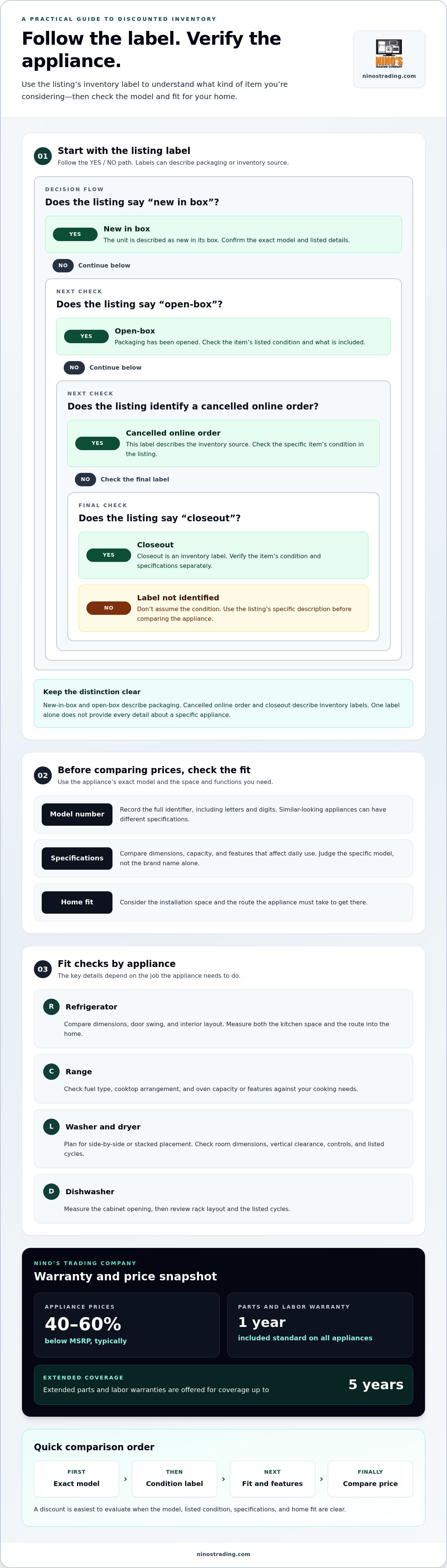
Start by identifying why an item is discounted. A closeout, open-box appliance, and scratch-and-dent unit represent different inventory situations. A cancelled online order may also enter discounted inventory without being an open-box return. The label offers context, but the model and condition still matter. Compare like with like by matching appliance type, model number, and condition.
Next, separate the reference price from the appliance’s actual value to you. A crossed-out figure is less useful than a clear comparison of the exact model and its features. For a range, consider fuel type, cooktop layout, and oven capacity. For a washer, compare dimensions and listed cycles. Choose features you’ll use, rather than paying attention only to a headline discount.
Use this short comparison process:
- Record the appliance type and full model number.
- Note its condition category and visible cosmetic marks.
- Compare dimensions and key features with your requirements.
- Review the warranty terms and included components.
- Compare the complete offer with similar models and conditions.
Warranty terms can affect a sale’s value. Read what parts and labor coverage includes, how long it lasts, and whether extended coverage is available. A listed price doesn’t explain those terms. Keep warranty details beside the model number to compare the full offer, not just the price.
Selection changes with inventory. A closeout depends on stock a seller is clearing, while open-box options depend on items with opened packaging entering stock. A specific model may sell before another appears. If you need a replacement soon, prioritize required dimensions and features. If your timing is flexible, compare other models as they become available.
Remember that costs beyond the appliance’s listed price may affect your total spending. Delivery, installation, and removal depend on the purchase arrangements, so consider them separately in your budget. A refrigerator that fits the kitchen still needs a workable route through the entryway. Planning for these practical details keeps a discount in perspective.
Rank your priorities before choosing: fit, essential features, condition, warranty, and total cost. Compare each item with that list. A new-in-box closeout and a marked open-box appliance may suit different shoppers. Choose the option that meets your practical needs and whose discount makes sense for its condition and coverage.
Overstock, open-box, and liquidated appliance sourcing
Inventory labels describe how appliances enter a discounted sale. Check the category, model, condition, and purchase terms before comparing options.
Assess an appliance by comparing its model and condition details with the written paperwork. Review the warranty and sales terms, and make sure the listing and purchase documents describe the item consistently.
Appliance Sourcing Categories
Overstock generally means a seller has more inventory than it currently needs. An appliance may still be new in its box, while a closeout may reflect a decision to clear a product line. Open-box inventory has had its packaging opened. Liquidated inventory is a broader category, so the label alone doesn’t explain an individual appliance’s condition.
Consider what the category means for the specific item. For an open-box refrigerator, compare the model label, packaging, visible condition, and included shelves. For a range described as overstock, confirm that the model and features match the appliance. A cancelled online order may also be new in its box, but the item’s condition still needs a clear description.
These categories can overlap in listings. A closeout may be new in the box, while an open-box item may also be part of liquidated stock. Don’t assume the inventory source determines the item’s condition. Compare the model number, condition description, and included parts before making a decision.
Inventory changes as appliances sell or arrive. If you need a particular refrigerator layout or range feature, keep that requirement in mind. Assess each listing against your needs rather than treating every discounted item as equivalent.
Checking Liquidator Reputation
Clear records are a practical starting point. Look for a specific model number, a clear condition description, and written warranty terms. An open-box listing should explain the item’s condition. Compare those details with the paperwork before buying.
Check how the seller describes scratch-and-dent units, cancelled orders, and open-box appliances. A useful description distinguishes these categories instead of grouping every item under one vague label. Compare the stated condition with the appliance itself. If they don’t match, clarify the difference before buying.
Make sure the purchase terms are understandable. The written documents should identify the appliance and explain any applicable coverage. Keep a copy of the model details and condition description to compare what was represented with what you receive.
Use a simple review process: read the listing, inspect the appliance, and compare both with the written terms. For example, make sure the model number on a range matches its paperwork. If the description changes between those steps, resolve the difference before deciding.
To compare discounted inventory by category, explore appliance options and review each item’s condition and model details.
Nino's Trading Company: Refrigerators
Nino's Trading Company helps shoppers compare refrigerators and other major appliances at reduced prices. Its inventory includes refrigerators, washers and dryers, ranges, and TVs, with options such as open-box, closeout, cancelled online orders, and new-in-box appliances. These are not used or refurbished products.
Each appliance includes a full 1-year parts and labor warranty, with extended parts and labor warranties available up to 5 years. Appliance prices typically run 40 to 60% below MSRP. If you’re comparing a refrigerator, start with the space it needs, its storage layout, and the features that suit your household.
For a practical next step, visit ninostrading.com to explore the available appliance options.
Choose the Appliance That Fits Your Next Move
Turn your priorities into a short, practical list: the appliance category, available space, and features you’ll use regularly. Keep condition and warranty terms in view as you compare. This helps you assess appliance liquidators’ options without letting a discount distract from fit or everyday usefulness.
Nino's Trading Company sells refrigerators, washers and dryers, ranges, and TVs. Start with the category you need, then compare the details that matter for your home. A focused shortlist makes the decision more deliberate.
For a straightforward next step, contact Nino's Trading Company today to discuss your appliance needs. Take your priorities with you, and move forward with a choice that suits your space and routine.
Frequently Asked Questions
What types of appliances do liquidators sell?
There’s no standard assortment of liquidated appliances. A listing should identify the appliance type and exact model. If you’re replacing a specific item, use its dimensions and required functions to narrow your options. That keeps the search focused on what fits your home instead of relying on a broad inventory label.
How much do appliances from liquidators typically cost?
There’s no single typical price for liquidated appliances. The model, features, condition, and seller’s pricing all affect the amount. For a useful comparison, focus on the exact model and its listed terms rather than a broad appliance category. A refrigerator with different dimensions or configuration may not be a meaningful price match, even if both listings use the same general product label.
How do appliance liquidator prices compare with new retail and used appliances?
Compare equivalent models and account for condition before judging price differences. A new retail item and a liquidated item may differ in packaging or cosmetic condition; a used appliance has a different ownership history. These distinctions make broad price comparisons unreliable. Check the model identifier and description to understand what each listing represents before assessing value.
Are appliance liquidator appliances new, open-box, refurbished, or scratch-and-dent?
Appliances may fall into different condition categories, depending on the item and seller. “New in box” describes an appliance still in its packaging; “open box” means the packaging has been opened. Scratch-and-dent refers to visible cosmetic damage. Refurbished describes a separate category involving prior work on an appliance. Read the item description carefully, since the category alone doesn’t explain every detail of its condition. For commercial kitchens and culinary businesses seeking reconditioned cooking appliances, specialist suppliers like Island Catering Equipment Co. provide serviced and inspected equipment.


