

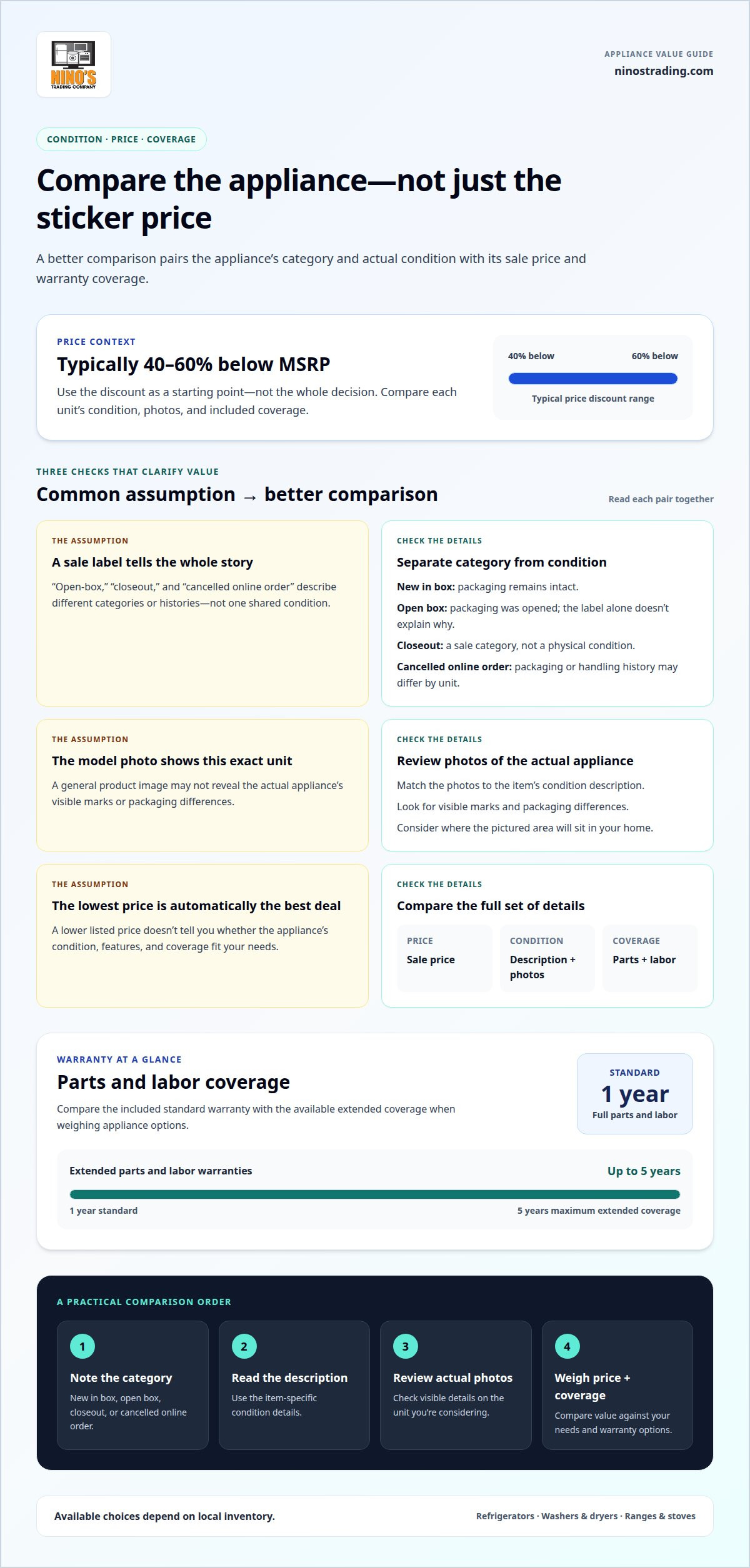
The lowest sticker price isn’t always the best appliance deal. At a Fayetteville AR discount appliance center, a useful comparison looks at the appliance’s condition, the sale price, and whether photos show the actual unit, not just the model. Appliance prices here typically run 40 to 60% below MSRP, with inventory that can include cancelled online orders, open-box items, closeouts, and new-in-box appliances.
It makes sense to want a lower price without guessing about an appliance’s condition. Compare the item description with photos of the actual unit to spot visible marks or packaging differences, and check local inventory to narrow your options. Discounted does not mean used or refurbished: Nino’s Trading Company sells neither.
This guide explains how condition affects value, what actual-unit photos can show, how to compare sale prices, and why local inventory matters when you’re shopping for refrigerators, washers and dryers, ranges, or stoves. You’ll also learn what the standard warranty includes and how extended coverage fits into the decision, so you can weigh the details that matter before choosing an appliance.
Key Takeaways
- Learn how appliance condition labels can help you compare options without treating every discounted item as the same.
- Use photos of the actual appliance to assess visible marks and details before deciding whether it suits your needs.
- Compare sale prices alongside condition and included warranty coverage, not as a standalone number.
- See how local inventory can shape the choices available for refrigerators, laundry appliances, and other essentials.
- Understand the standard parts-and-labor warranty and the available extended coverage options.
New, open-box, used, and scratch-and-dent appliances
Appliance labels describe different categories, not one shared condition. A new-in-box refrigerator differs from an open-box washer, even when both are discounted. At a discount appliance center, read the category alongside the item’s condition details. Nino’s Trading Company carries new-in-box, open-box, closeout, and cancelled online order appliances. Used and refurbished appliances aren’t sold.
“New” usually means the appliance has not been used. “New in box” also describes packaging that remains intact. Open-box means the packaging was opened, but the label alone doesn’t explain why. An order may have been cancelled before delivery, or packaging may have been opened for another reason. Compare the description and photos of the actual unit rather than assuming every open-box item has the same history.
Closeout describes a sale category, not a physical condition. It can apply to a new appliance being cleared from inventory. A cancelled online order can have a different packaging or handling history from a closeout. For example, two refrigerators may have similar sale labels but different visible packaging. Check the item’s condition description to distinguish them.
Scratch-and-dent appliances have visible cosmetic marks that vary by unit. One refrigerator might have a small mark on a side panel, while another may have a dent on its door. The label doesn’t tell you the mark’s size or location. Look at photos of the actual unit and consider whether the pictured area will be visible in your kitchen. A scratch on a side facing a cabinet may matter less than damage on a front panel.
Compare options in a consistent order: note the category, read the condition description, then review photos of the actual unit. For a washer, check the visible exterior and control area in the images. Finally, consider whether the appliance’s appearance and price suit its intended spot. Keep cosmetic condition separate from the sales category, since open-box and scratch-and-dent describe different things.
Do local stores haul away old appliances? Haul-away is separate from whether a replacement is new, open-box, or scratch-and-dent. Store arrangements differ, so don’t assume removal is included with an appliance purchase. Treat old-unit removal as a separate part of the delivery decision, alongside the appliance’s condition and the space it will occupy.
Refrigerators and kitchen appliances
Start choosing a refrigerator by measuring the space and considering your household routine. Measure the opening, including nearby counters and cabinets. Then consider door swing, handle clearance, and the route into the kitchen. A refrigerator may fit the opening but still be awkward if its doors meet a wall. For example, a narrow kitchen doorway can limit which models are practical.
Next, decide what the appliance needs to store. A household that freezes meals may prefer a refrigerator with freezer space suited to those items. Someone with a separate freezer may prioritize fresh-food storage instead. Make a short list of must-haves before comparing models. That keeps useful features ahead of finishes or extras that won’t meet a daily need.
Kitchen layout also shapes the choice. A refrigerator beside a range needs room for its doors and nearby work surfaces. A unit near a pantry may affect how easily people move through the cooking area. If replacing an existing appliance, note its location and how the doors open. Those details help you compare a new refrigerator with the space you already use.
Compare refrigerators and freezers by intended use, not category name alone. An upright freezer offers a different storage arrangement from a refrigerator-freezer combination. A separate freezer can suit bulk storage, while a combination unit keeps everyday items together. Consider where frozen food will go, how often you access it, and whether another appliance already handles that job.
- Measure the space: Record the opening, nearby obstacles, and delivery path.
- Map the doors: Consider walls, counters, and traffic through the kitchen.
- Sort storage needs: Separate fresh food, frozen food, and bulk items.
- Compare condition: Review each unit’s description and photos before weighing its appearance.
- Prioritize daily use: Choose around your routine, rather than features you rarely need.
Use the same checklist for each option. For instance, compare two refrigerators by fit, door movement, storage arrangement, and condition. A closeout or open-box label describes a sales category, but each appliance still deserves its own review. Match the details to your kitchen and routine instead of assuming similar labels mean identical choices.
For a practical next step, browse the refrigerator options and compare each unit with your kitchen measurements and storage needs.
Appliance sale prices and discounts
A discount matters most when the appliance suits your needs and its condition. Compare the sale price with the appliance’s category, visible condition, and purchase terms. A lower listed price may reflect a closeout, open-box status, or cosmetic marks. Those categories describe different things, so compare the specific unit rather than the label alone. At a Fayetteville AR discount appliance center, comparing individual units makes the price easier to assess.
Use a consistent method for each refrigerator, range, or washer. First, note the listed price and condition category. Next, review the description and photos of the actual appliance. Then consider whether its features and appearance fit your household. For example, a scratch on a refrigerator’s side may matter less if that panel faces a cabinet.
Price differences can reflect the model, sales category, and condition. A discount percentage alone won’t tell you whether two appliances are comparable. Match appliances by type and model where possible, then compare listed prices and visible details. If the models differ, focus on the features and condition that matter for your home. Comparing two ranges, for instance, is more useful when both meet the same cooking needs.
All appliances here include a full 1 year parts-and-labor warranty. Extended parts-and-labor warranties are also available up to 5 years. Return terms are separate from warranty coverage, so read the applicable purchase terms as well. Keeping those details together helps you understand both the included coverage and any return conditions before choosing.
Coverage can be one factor when weighing similar sale prices. Compare the warranty duration and what it covers, then consider whether extended coverage suits your preference. Keep that decision separate from the appliance’s condition. A warranty doesn’t replace reviewing the description or photos of the actual unit, and cosmetic details still matter when deciding where an appliance will sit.
A short comparison note can keep the details organized. Record the model, listed price, condition category, visible marks, and warranty terms for each option. If two refrigerators seem similar, those details may explain why their prices differ. The same approach works for washers or ranges, especially when comparing appliances with different sales categories.
- Compare similar options: Match appliance type, model, condition, and relevant features.
- Review the specific unit: Use its description and photos to understand visible condition.
- Separate coverage terms: Consider warranty coverage independently from return terms.
- Weigh the overall fit: Consider price alongside condition and household needs.
For shoppers comparing options at a Fayetteville AR discount appliance center, the strongest deal is the appliance whose price, condition, and terms fit their needs. A refrigerator with a side mark may suit a kitchen where that panel stays hidden, while another buyer may prefer an unmarked unit. Compare each choice in context instead of letting the lowest listed price make the decision.
Appliance condition disclosures and actual-unit photos
A condition label is a starting point, not the full picture. For a scratch-and-dent refrigerator, the description should identify visible cosmetic damage. Photos of the actual unit can show where the mark is. Compare the wording with the image, then consider whether its location matters in your kitchen.
Look for specific, visible details in descriptions. “Dent on the side panel” gives more useful context than “minor cosmetic damage.” A photo can help distinguish a side-panel mark from one on the front door. If the appliance sits beside a cabinet, the side may be less visible. A front-facing mark may affect how the unit looks every day.
Use the same viewing sequence for each listing. Start with the full-appliance image to understand its overall appearance. Then inspect close-ups of the area named in the condition description. Compare the door, sides, corners, and control area when those views are available. For a range, look at the front and visible cooktop surface. For a washer, examine the exterior and controls.
- Match words to images: Find the disclosed mark in the actual-unit photo.
- Locate the damage: Note whether it appears on a front, side, corner, or top.
- Consider placement: Picture the marked area in the appliance’s intended spot.
- Compare units: Separate cosmetic differences from other listed details.
Photos show appearance, not every part of an appliance’s history or operation. A picture of a clean refrigerator exterior cannot establish how it performs. Consider visual evidence separately from condition wording, warranty coverage, and other written details. Each answers a different part of your comparison.
Lighting and camera angle can change how a mark appears. A reflection on a refrigerator door may look like a scratch, while a close-up can clarify its shape. Check whether an image shows the area directly rather than relying only on a distant view. If several images show different sides, use them together instead of judging from one angle.
For open-box appliances, packaging and visible exterior condition are separate considerations. An opened carton doesn’t automatically explain the appliance’s appearance. Use the listed category to understand its sales status, then review the unit-specific description and photos for visible details. For example, two open-box washers may look different, so the category alone won’t tell you which suits your laundry space.
Before comparing your final choices, write down the condition phrase and visible detail for each unit. A note such as “door mark, lower right” is clearer than “some damage.” This simple record helps you compare a refrigerator with a range, or two similar units, without losing track of which image showed each detail.
Discount appliance inventory near Fayetteville
Near Fayetteville, inventory can vary by appliance type and condition. Compare individual units, not just store categories.
Available Appliance Inventory
Start with the appliance you need, then compare available units. Refrigerators, ranges, washers, and televisions serve different household needs. Fayetteville-area inventory may include closeouts, open-box items, cancelled online orders, and new-in-box appliances. For each choice, consider the listed condition, photos of the actual unit, and model details together.
Inventory changes as individual units sell or arrive. A useful comparison records the appliance type, condition category, model, and visible details. For example, two refrigerators may differ in packaging or appearance despite serving the same purpose. Separate those differences from the features that matter in your home.
Store and Seller Comparisons
Compare a local discount center, a big-box retailer, and an online seller using the same criteria. Match appliance type and model where possible, then compare condition, sale terms, warranty coverage, and how clearly the unit is represented. A listing for a specific appliance makes a more useful comparison than a general storewide discount claim.
Online listings can make model details easy to compare, while an in-person visit may let you view a unit directly. Neither format replaces checking the actual condition and purchase terms. For example, compare a local open-box refrigerator with a new-in-box option using its listed details, not the category name alone.
Store Addresses and Hours
Addresses and opening hours are specific to each Fayetteville store. Use the individual store’s current listing when planning a visit, since a general inventory description doesn’t tell you where or when a seller operates. Keep the location and hours with the store name in your notes.
For example, when comparing two locations, record each address and schedule separately. That keeps store logistics distinct from appliance details such as condition or model. If you plan to view a particular refrigerator, align your visit with the location listing that unit.
Available Appliance Brands
Brand selection depends on the individual appliance inventory. Compare the brand and model shown for each refrigerator, range, or washer rather than assuming every Fayetteville seller carries the same names. Brand alone also doesn’t describe condition, features, or warranty terms.
Use model information to compare equivalent appliances across sellers. For instance, note whether two listings describe the same model before comparing condition and sale terms. If the models differ, focus on features and details that match your household needs.
For a focused next step, explore current appliance inventory and compare the listed units with your needs.
Nino's Trading Company: Cancelled Online Appliance orders
Nino’s Trading Company offers cancelled online appliance orders for shoppers comparing discounted home appliances. These orders are an option alongside open-box, closeout, and new-in-box inventory. Review each appliance’s own condition details to understand what you’re considering.
Nino’s Trading Company carries refrigerators, washers and dryers, and TVs. Start with the category you need, then compare the specific unit’s condition, photos, and sale details. For example, a refrigerator for a kitchen replacement calls for different priorities than a washer for a laundry room. Looking at those details together helps you choose based on fit, not just the order category.
If you’re weighing cancelled online orders against other discounted options, contact Nino's Trading Company to discuss your appliance needs.
Choose the Appliance That Fits Your Next Step
Start your next appliance decision with a practical question: what needs to work better at home? A refrigerator may meet a kitchen need, while washers and dryers address laundry, and a TV may suit another room. Keeping that priority in view helps narrow the options without getting distracted by details that don’t matter to your household.
When choosing a Fayetteville AR discount appliance center, focus on an appliance that fits your space, routine, and preferences. Nino’s Trading Company carries refrigerators, washers and dryers, and TVs to consider for everyday needs. Browse the selection and compare the details that matter to you.
Contact Nino's Trading Company to discuss the appliance you’re looking for. A clear sense of your needs is a good place to begin, and the right choice can make daily routines feel more convenient.
Frequently Asked Questions
What discount appliance stores are in Fayetteville, AR?
Nino’s Trading Company serves shoppers in Fayetteville and nearby communities, including Springdale, Rogers, and Bentonville. Its regional service area also includes Little Rock, Fort Smith, Tulsa, Oklahoma City, Broken Arrow, Yukon, Mustang, and Edmond. Start with the appliance category you need, then review the specific item’s details. This helps distinguish local options without assuming every community has a separate storefront.
What are typical prices for discounted refrigerators, washers, dryers, and ranges in Fayetteville?
Prices depend on the appliance, model, condition category, and current inventory, so one typical amount wouldn’t represent every refrigerator, washer, dryer, or range. Compare the listed price for the particular unit you’re considering rather than applying one price to an entire appliance type. A model number can help distinguish similar-looking items and keep your comparison focused on genuinely comparable appliances.
Do Fayetteville appliance centers sell cancelled online orders, closeouts, or open-box appliances?
Nino’s Trading Company offers open-box appliances, cancelled online orders, closeouts, and new-in-box products. These categories aren’t interchangeable, so use the label for the item you’re considering.
Are financing, payment plans, or seasonal discounts available at Fayetteville appliance stores?
Financing, payment plans, and seasonal discounts are store-specific offers, not automatic parts of an appliance purchase. Compare the terms shown for the particular appliance and promotion, including which items qualify and when the offer applies. For example, a seasonal discount may apply to selected inventory rather than every refrigerator or range. Don’t include a payment plan in your budget unless its terms are presented with the purchase.
What should buyers check before purchasing a discounted or open-box appliance?
Match the model number on the appliance to its listing or purchase paperwork, then compare the condition description with the actual unit. Note any visible marks and their location, and whether they will face outward in your room. Review the included paperwork and keep a copy of the item description. These steps give you a clear record of the specific appliance and its disclosed condition.


