
The biggest mistake you can make when shopping for a stackable washer and dryer is assuming that exterior machine dimensions tell the whole story. If you find yourself asking how much space you really need for vertical laundry, you aren't alone. It's completely reasonable to worry about whether a tall setup will rattle against your closet walls, crowd a door frame, or leave enough breathing room for thick dryer venting and water lines. Sorting through the differences between individual front-load pairs and unitized laundry towers can feel just as tricky.
Getting vertical laundry right comes down to planning your utility clearances before you buy. In this guide, you'll learn how these configurations work, how to measure closet depth, height, and hookup spacing with total accuracy, and how to pick a dependable, high-efficiency set built for your household routine. We'll walk step-by-step through required clearances, design types, and essential features so you can reclaim valuable square footage without sacrificing everyday washing performance.
Key Takeaways
- Calculate realistic closet depth by adding dedicated margins for rear venting, plumbing hookups, and machine vibration.
- Understand how an individual stackable washer and dryer setup relies on heavy-duty manufacturer brackets to keep stacked units stable.
- Compare modular front-load pairs against integrated laundry towers to decide which control layout fits your reach and laundry routine.
- Reclaim square footage in tight hallway closets and utility alcoves without giving up large-capacity washing performance.
- Secure dependable, name-brand laundry sets on a sensible budget by considering high-grade open box and scratch-and-dent appliances.
What Is a Stackable Washer and Dryer Setup?
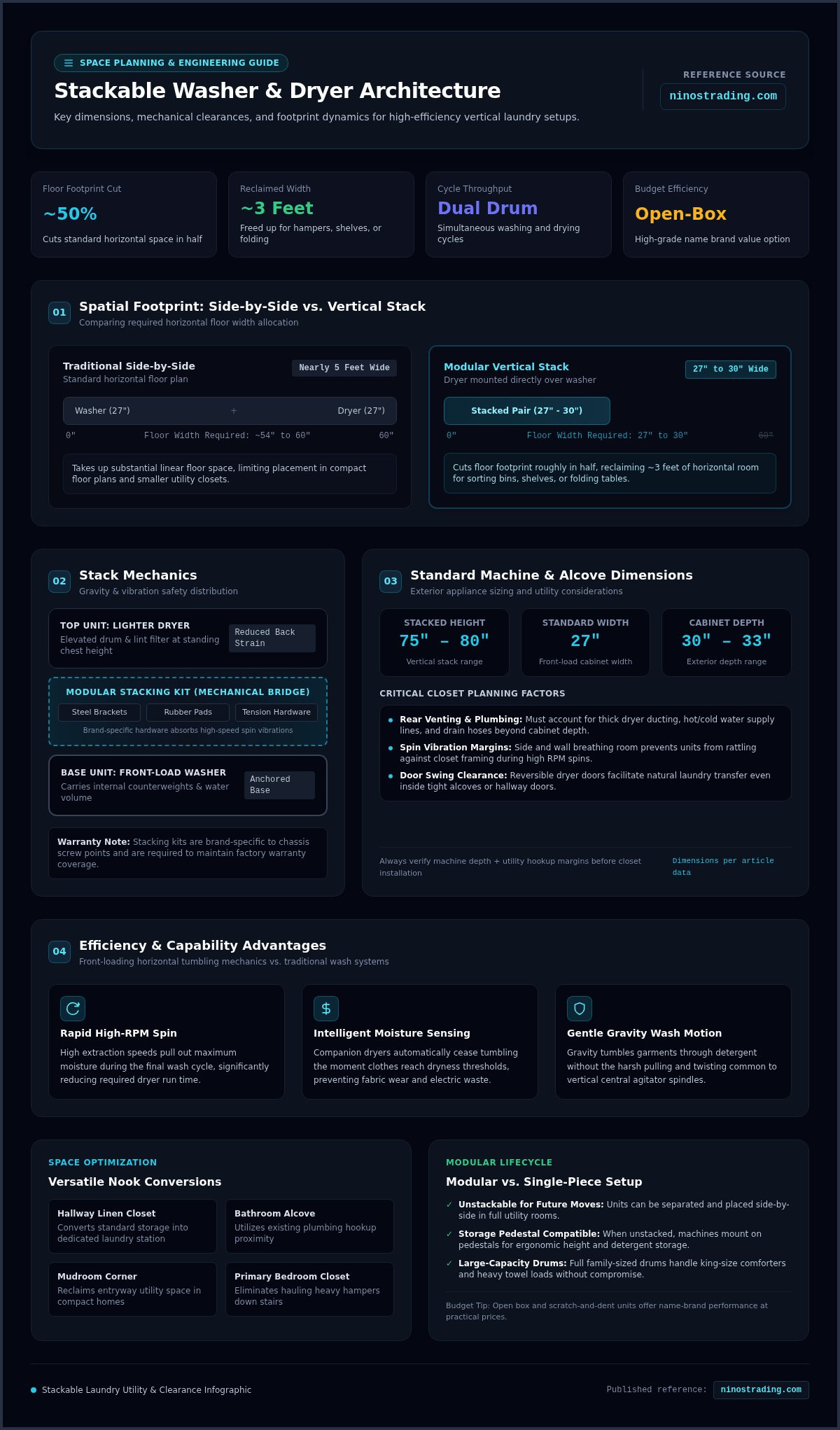
A stackable washer and dryer setup pairs two individual, front-loading appliances by mounting the dryer directly on top of the washer. Because washing machines carry heavy internal counterweights and fill with gallons of water during cycles, they always serve as the anchored base. The lighter dryer sits securely above. Arranging your laundry vertically cuts the required floor footprint roughly in half, taking up about 27 to 30 inches of horizontal floor width instead of nearly five feet.
Many shoppers worry that choosing a stacked configuration forces them to compromise on wash capacity. Fortunately, modern front-loaders deliver full, family-sized drum volumes capable of handling king-size comforters and heavy towel loads. Unlike single-drum washer-dryer combo units that wash and dry within the exact same cavity, a true stacked pair lets you run both cycles simultaneously to keep household laundry moving without interruption.
How Modular Stacking Kits Function
Placing a dryer on top of a washer without proper anchoring creates a severe safety hazard. A modular stacking kit provides the mechanical bridge that locks the appliances together. These kits feature heavy-duty steel brackets, high-density rubber pads, and rear tension hardware that absorb high-speed spin vibrations. By isolating movement, the brackets prevent the upper unit from shifting, walking, or scratching the washer cabinet. Because outer chassis dimensions and screw points differ across manufacturers, these kits are brand-specific and required to maintain your factory warranty coverage.
Stackable Pairs vs. Side-by-Side Flexibility
Investing in a modular stackable washer and dryer set gives you long-term flexibility that single-piece machines cannot match. If you move from an apartment into a home with a full utility room, you can unstack the units and set them side by side. This horizontal arrangement allows you to add optional storage pedestals beneath the machines, raising them to an ergonomic working height while hiding detergent and laundry supplies. Most dryers also feature field-reversible doors, allowing you to switch the swing direction so transferring wet clothes stays quick and natural, even in tight corners.
Key Benefits of Stackable Laundry for Small Spaces
Switching to a vertical setup fundamentally changes how you can organize a home. By lifting the dryer off the floor, you immediately reclaim nearly three feet of usable horizontal room. That open area can quickly become a sorting hamper zone, a set of utility shelves, or a folding counter. Beyond floor recovery, an elevated dryer brings the drum and lint filter up to standing chest height, making daily loading and unloading much easier on your lower back.
Maximizing Square Footage in Compact Floor Plans
Modern townhomes, urban apartments, and older ranch layouts often skip dedicated utility rooms entirely. A stackable washer and dryer allows you to convert an unused hallway linen closet, a bathroom alcove, or a mudroom corner into an efficient wash center. Vertical configurations are also ideal for adding a secondary laundry station inside a primary bedroom closet, saving you from hauling heavy hampers down the stairs every week. If you are mapping out a tight utility nook, browsing options at local appliance showrooms can give you a clear look at how different cabinet depths work in real spaces.
Energy and Water Conservation Advantages
Because stackable front-load washers rely on horizontal tumbling rather than filling an entire tub with water, they use a fraction of the resources required by traditional top-load agitators. Investing in ENERGY STAR certified models lowers your monthly utility consumption while delivering superior stain removal.
- Higher extraction speeds: Front-load drums spin at rapid RPMs, pulling out significant moisture so clothes require far less time in the dryer.
- Intelligent moisture sensing: Modern companion dryers automatically stop tumbling when clothes reach dry thresholds, preventing fabric wear and wasted electricity.
- Gentle wash motion: Gravity tumbles garments through detergent without the harsh pulling and twisting common to vertical central spindles.
How to Measure Closets and Utility Clearances Accurately
Fitting a vertical laundry setup into a tight alcove requires measuring for physical utilities rather than cabinet dimensions alone. Most standard front-load machines are 27 inches wide and 30 to 33 inches deep, standing roughly 75 to 80 inches tall when stacked. However, sliding a stackable washer and dryer into an opening that matches those numbers exactly leads to blocked doors, crushed venting, and wall damage. Proper planning follows four distinct steps: measuring physical closet volume, adding utility margins, checking hookups, and mapping delivery pathways.
Accounting for Critical Depth and Rear Clearances
Depth causes the most installation headaches. Rigid metal exhaust ducts, cold and hot water hoses, and drain lines require four to six inches of buffer space behind the appliances. To prevent drywall damage from regular spin cycles, you also need at least one inch of breathing room along each side and two inches above the dryer. If your closet depth is tight, installing a recessed vent box inside the wall allows the exhaust transition duct to tuck flush, saving up to four inches of valuable depth.
Verifying Electrical, Gas, and Plumbing Hookups
Before ordering your pair from Nino's Trading Company, inspect the utilities already inside your utility closet. Following safe dryer venting guidelines and utility checks protects your home and keeps machines running efficiently:
- Electrical supply: Front-load washers run on standard 120-volt grounded outlets, while electric companion dryers require a dedicated 240-volt circuit with a 3-prong or 4-prong receptacle.
- Gas lines: Gas-heated dryers demand an active gas shutoff valve, an approved flexible stainless steel line, and rigid exterior metal ducting.
- Drainage height: Ensure your plumbing standpipe sits between 36 and 96 inches high to prevent wastewater siphoning back into the wash tub.
Measuring Delivery Access Routes Across the Home
A stackable washer and dryer pair won't do much good if it cannot clear the front hallway. Measure exterior entry doors, basement turns, and interior stairwells before delivery day. Take note of protruding banisters and door moldings. If clearances are tighter than 30 inches, taking closet doors off their hinges or popping off passage trim often provides the extra inch needed to navigate bulky appliances safely inside.
Stackable Front-Load Pairs vs. Unitized Laundry Centers
Shoppers looking for vertical laundry generally run into two distinct categories: modular pairs joined by hardware, and single-piece unitized laundry towers. While both designs stack the dryer above the washer, their internal construction, controls, and long-term ownership dynamics are completely different. A modular stackable washer and dryer uses two independent, standalone machines engineered to operate either separately or together. A unitized center, by contrast, houses both drums inside one connected steel chassis, sharing a central brain and internal wiring harness.
Performance, Capacity, and Feature Differences
Modular front-load sets feature full residential capacities, typically offering between 4.5 and 5.2 cubic feet in the washer drum. That generous volume lets you wash bulky bedding, heavy denim loads, and large batches of family laundry without hesitation. Because the dryer sits higher up, reaching the controls on modular pairs can sometimes challenge shorter users.
Unitized laundry towers solve this reach issue by placing a unified control panel right in the middle, between both drums. Classic unitized models often run on narrower 24-inch or 27-inch footprints with smaller tub capacities, making them popular in rental apartments. Newer high-end models, however, now offer full-size capacities alongside integrated sensors that automatically match dryer settings to the wash cycle you just ran.
Long-Term Maintenance and Repair Considerations
Your choice between these two formats plays a major role in future service calls. Modular sets provide distinct maintenance advantages over time:
- Independent machine replacement: If a washer motor fails after years of heavy use, you only need to swap the washing machine. The upper dryer keeps working just fine.
- Hardware reusability: When upgrading machines within the same brand line, existing stacking brackets can frequently be transferred to the new units.
- All-in-one chassis risks: With a unitized tower, a serious internal electrical issue or motor failure on either half can take down the entire system or require replacing the complete double-decker unit.
When you are ready to explore both configurations in person, shop available washers and dryers to compare central control access against modular setups side by side.
How to Shop for Quality Stackable Sets on a Practical Budget
Getting dependable laundry performance does not require overspending on cosmetic upgrades. When shopping for a stackable washer and dryer, prioritize core mechanical hardware over decorative trims or unnecessary digital bells and whistles. Direct-drive motors, stainless steel wash drums, and genuine steam sanitizing cycles provide lasting everyday value. Fancy finishes and smartphone cycle alerts look sleek in brochures, but they rarely clean your clothes any better than sturdy, standard-finish models.
The Value of Open Box and Scratch-and-Dent Inventory
If you want top-tier washing performance without paying premium retail prices, open box and scratch-and-dent appliances represent the smartest avenue available. Most of these units arrive from cancelled builder orders, undelivered freight, or minor scuffs that happened during warehouse transit. Because a stacked laundry set usually lives tucked between drywall partitions or inside a dedicated closet, side-panel cosmetic blemishes remain completely hidden once installed. The internal suspension, pump motors, and drum mechanics remain untouched and fully warrantied, allowing you to secure higher-tier wash programs and durable parts while protecting your household budget.
Why Regional Appliance Outlets Beat Impersonal Big-Box Chains
National retail chains often rely on third-party delivery contractors and scripted floor sales. Shopping with an established regional specialist gives you distinct practical advantages:
- Physical model inspection: You can see and touch floor inventory, examine door latch mechanisms, and inspect unboxed units in person before arranging delivery.
- Local utility expertise: Knowledgeable floor staff can review your rough closet measurements and discuss real-world venting configurations without high-pressure sales tactics.
- Reliable inventory access: Regional warehouses serving Little Rock, Northwest Arkansas, and the Oklahoma City and Tulsa areas keep products nearby for rapid local fulfillment.
Bringing your rough hallway or alcove measurements to an experienced regional team takes the guesswork out of tight installations. Take a look at available name-brand closeout and scratch-and-dent laundry pairs at Nino's Trading Company to find an efficient vertical setup that fits your living space.
Maximize Your Floor Plan With the Right Laundry Pair
Creating an efficient laundry area in a tight space starts with honest measurements and clear utility planning. When you account for rear duct clearance, choose between modular units and integrated towers, and lock in front-load energy efficiency, you transform cramped corners into functional utility hubs. Installing a quality stackable washer and dryer allows you to claim back valuable square footage without compromising on cycle performance or tub capacity.
You don't have to tackle this upgrade alone or overspend to secure reliable performance. With multiple regional warehouse locations serving Arkansas and Oklahoma, our team provides straightforward guidance on utility hookups and real-world spatial fit. Explore our extensive inventory of open box and scratch-and-dent appliances to find premium features that fit your layout and your household budget. Find dependable, space-saving laundry sets at Nino's Trading Company and start enjoying a practical, clutter-free home today.
Frequently Asked Questions
Can you stack any front-load washer and dryer together?
No, you cannot safely stack just any random front-load washer and dryer together. Proper stacking requires matching cabinet dimensions and aligned chassis mounting points. Manufacturers engineer stacking brackets for specific companion pairings within their own product lines. Mixing different brands or pairing mismatched depths creates severe stability hazards and voids equipment warranties. For homeowners across Arkansas and Oklahoma, checking manufacturer compatibility lists ensures safe, quiet operation.
How much extra space is needed behind a stackable washer and dryer?
Plan for four to six inches of dedicated clearance behind your stackable washer and dryer. This rear depth accommodates rigid metal exhaust ducting, hot and cold water fill hoses, and drainage standpipes without dangerous kinks. Crushing flexible dryer ductwork restricts airflow, creating fire hazards and extending drying cycles. If your closet depth is limited, installing a recessed dryer vent box reduces this clearance requirement to about two inches.
Do you need a special stacking kit to stack a washer and dryer?
Yes, you must always use a manufacturer-approved stacking kit when stacking separate laundry units. Placing a dryer directly on top of a washer without steel locking brackets invites disaster. Washing machines spin at speeds exceeding 1,200 RPM, creating strong vibrations that can easily walk an unsecured dryer off the top. Stacking kits include custom metal brackets and rubber isolation pads that anchor the upper dryer firmly to the washer frame.
Can a stackable dryer run on a standard 120-volt wall outlet?
Most electric stackable dryers cannot run on a standard 120-volt household outlet. Full-size residential electric dryers require a dedicated 240-volt circuit with a 30-amp breaker to power heating elements. Only gas dryers and compact ventless heat-pump models operate using standard 120-volt wall receptacles. Always verify the outlet configuration inside your utility closet before purchasing a replacement set in showrooms across Little Rock, Northwest Arkansas, or Oklahoma City.
What is the difference between a stackable set and a laundry center?
A stackable set consists of two independent machines, while a laundry center is a single unified appliance. Modular stackable pairs let you purchase, replace, or repair the washer or dryer separately. Laundry centers join both drums inside a continuous metal cabinet with shared controls in the center. If one section of a laundry center experiences terminal motor failure, you typically must replace the entire combined system.
Are stackable washers and dryers as durable as traditional side-by-side sets?
Yes, a stackable washer and dryer provides the exact same durability and lifespan as traditional side-by-side setups. Modular stackable units are identical to standard front-load machines placed side by side. Stacking them vertically with certified hardware doesn't place extra stress on internal drive motors, suspension springs, or drums. Routine maintenance, including cleaning door gaskets and lint traps, keeps these units operating reliably for years.
Can you safely unstack a stackable washer and dryer if you move?
Yes, you can safely unstack your modular laundry pair whenever you move to a new home. Because modular setups rely on removable exterior brackets rather than permanent factory welds, disassembling them takes only a few minutes with basic hand tools. You can reinstall them side by side in a larger utility room or add optional storage pedestals underneath. Remember to keep the leveling legs properly adjusted after repositioning.


