

A scratch is easy to spot, but the key question is whether the freezer works as expected. When assessing scratch-and-dent freezers in Springdale, look beyond the mark: find out what functional testing covered, read the condition details, and consider visible damage in context. Cosmetic wear and operating condition are separate things, and neither should be judged by appearance alone.
It makes sense to want a clear picture of an appliance before deciding whether it suits your needs. This guide explains how functional testing, condition details, and a careful visual inspection can help you assess a freezer. You’ll learn what testing can tell you, how written details clarify its condition, and which visible signs deserve closer attention. Start by considering how the appliance operates, then compare its documented condition with the marks you can see. The goal is to weigh function and appearance together, rather than treating a scratch as proof of a problem or a clean exterior as proof of performance.
Key Takeaways
- Separate cosmetic marks from signs that could affect a freezer’s operation by looking at the damage’s location and condition notes.
- Use the available testing information to understand what has been checked, and what it can tell you about the appliance’s function.
- Consider energy use and operating costs in light of the freezer’s condition and how it will be used at home.
- Learn how condition records and visible inspections can help you make a more informed choice among scratch-and-dent appliances.
- Understand how Nino's Trading Company’s appliance warranties can factor into your decision.
Scratch-and-dent condition inspection
Start with the freezer’s condition details, then compare them with the appliance in front of you. A useful description identifies visible marks clearly, such as a dent on the left side or a scratch near the lower door. That helps distinguish cosmetic damage from concerns that need closer inspection. When assessing scratch-and-dent freezers in Springdale, match each described mark to its actual location and check whether the doors, drawers, and other parts function properly.
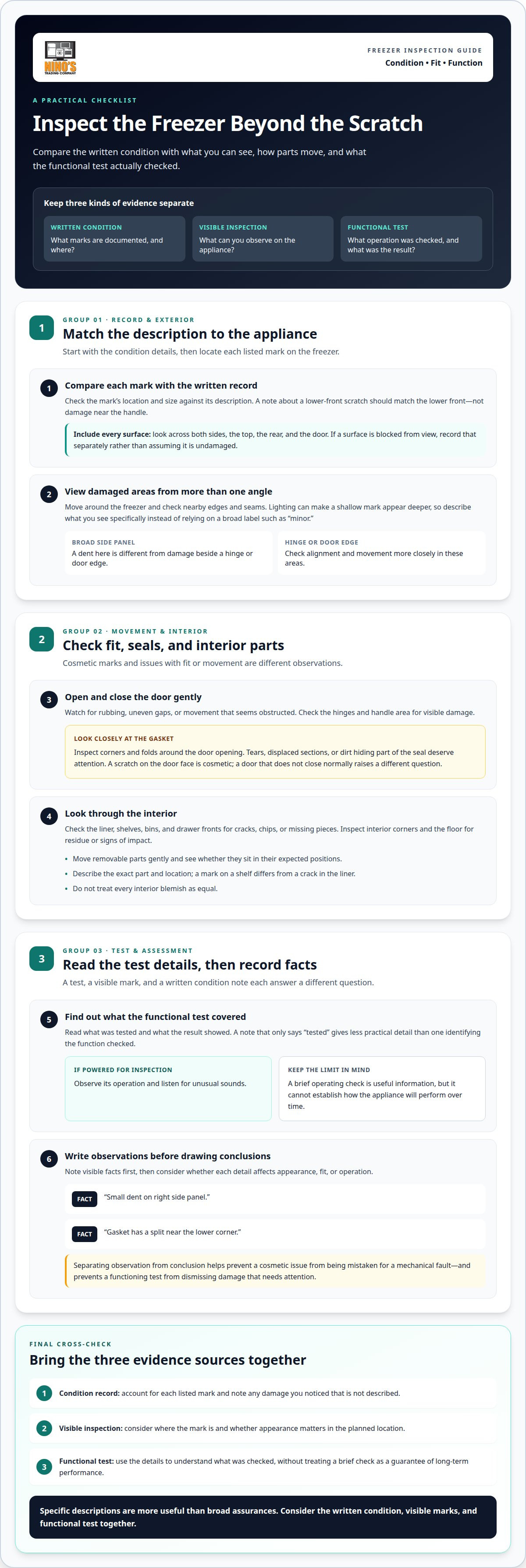
Inspect the freezer in a steady sequence, moving from the outside to the inside. View each damaged area from more than one angle, since lighting can make a shallow mark appear deeper. Then check nearby edges, seams, and moving parts. A dent on a broad side panel differs from damage beside a hinge or door edge, where alignment and movement matter. Describe what you see specifically instead of relying on labels such as “minor.”
- Compare the record with the exterior. Find each listed mark, then check its position and size against the written description. For example, a note about a lower-front scratch should correspond to a mark on the lower front, not damage near the handle. Look across both sides, the top, the rear, and the door. If a surface is blocked from view, note that separately instead of assuming it is undamaged.
- Examine the door and its movement. Open and close the door gently, watching for rubbing, uneven gaps, or movement that seems obstructed. Check the hinges and handle area for visible damage. Look at the gasket around the door opening, including corners and folds. Tears, sections that appear displaced, or dirt hiding part of the seal deserve attention. A scratch on the door face is cosmetic; a door that does not close normally raises a different question.
- Look through the interior. Check the liner, shelves, bins, and drawer fronts for cracks, chips, or missing pieces. Move removable parts gently to see whether they sit in their expected positions. Inspect the interior corners and floor for residue or signs of impact. For example, a mark on a shelf differs from a crack in the liner, so describe the exact part and location. Don’t treat every interior blemish as equal.
- Review the functional test details. Read any record describing what was tested and what the result showed. A note that only says “tested” gives less practical detail than one identifying the function checked. If the freezer is powered for inspection, observe its operation and listen for unusual sounds. A brief operating check is useful information, but it cannot establish how the appliance will perform over time.
- Separate observation from conclusion. Write down visible facts first, such as “small dent on right side panel” or “gasket has a split near the lower corner.” Then consider whether the detail affects appearance, fit, or operation. This keeps a cosmetic issue from being mistaken for a mechanical fault, and prevents a functioning test from dismissing damage that needs attention.
Before deciding, compare the condition details with the freezer once more. Account for each listed mark and make sure any other damage you noticed is described accurately. If appearance matters in the planned location, consider which panels will remain visible. A mark on a side facing a wall may matter less visually than damage on the front, but function and fit are separate considerations.
A useful inspection relies on specific descriptions, not broad assurances. “Dent on left side panel” tells you more than “some wear”; “door closes without rubbing” describes an observed result. Keep those observations distinct. The written condition, visible marks, and functional test each answer different questions. Consider them together before deciding whether the freezer suits your household.
Are scratch and dent freezers energy efficient, and what are their operating costs?
A scratch or dent alone doesn’t reveal how much electricity a freezer uses. Energy use depends on the appliance’s design, condition, settings, and surroundings. A mark on an exterior panel may be cosmetic, while a damaged door seal can affect how well cold air stays inside. Assess the freezer’s energy information and operating condition separately. That gives you a more useful picture than judging efficiency by appearance alone.
Start with the model’s energy label or product documentation. Check its stated electricity use and compare it with similar freezers of a similar size and type. A larger freezer may use more electricity overall, but storage capacity matters too. Consider how much usable space your household needs. An oversized appliance can mean paying to cool space you rarely use, while a smaller model may not suit regular bulk storage.
To estimate electricity expense, multiply the model’s stated annual energy use by your electricity rate per unit of energy. This gives an estimate, not a guaranteed bill. Actual costs can vary with local rates, how often the door opens, room temperature, and how much food is inside. For example, frequent opening in a warm utility room can make a freezer work harder than occasional access in a cooler location.
When assessing a scratch-and-dent appliance, consider whether visible damage could affect operation. Inspect the door edge and gasket for gaps, tears, or sections that don’t sit evenly. Check that the door closes without obstruction. A dent on a side panel may not affect energy use, but damage near the door opening deserves closer attention. Note whether the condition details describe the area and any functional testing. This helps distinguish a cosmetic mark from a possible air-leak concern.
- Match energy figures carefully. Compare models with similar capacity and freezer type, rather than choosing by appearance alone.
- Check the seal and closure. Look for visible gaps, damaged gasket sections, or a door that doesn’t close smoothly.
- Think about placement. A warm area or restricted airflow around the appliance can affect how often it needs to run.
- Consider your routine. Frequent door openings and repeated searches for stored food can add to operating demand.
Placement and everyday habits matter after installation, too. Leave room for air to move around the appliance as its instructions recommend, and avoid placing it beside a heat source. Keep commonly used items easy to find. If the freezer will be in a garage or other warm space, consider that environment when assessing expected use. Don’t assume two appliances will have identical operating costs simply because their exterior dimensions look alike.
There’s no reliable operating-cost estimate for every freezer without its energy-use information and your household’s electricity rate. Use the model’s stated consumption as a starting point, then consider where it will operate. A sound door seal, suitable placement, and sensible access habits help complete the picture alongside visible condition. Energy efficiency depends on the model and how it’s used, not on whether it has a scratch or dent.
Nino's Trading Company: Scratch and Dent appliances
Nino's Trading Company offers scratch-and-dent appliances for shoppers weighing cosmetic condition against function. After reviewing a freezer’s visible marks, condition record, and energy information, consider whether an appliance with cosmetic damage fits your needs. All appliances come with a full 1 year parts and labor warranty, with extended parts and labor warranties available up to 5 years. Those terms can be part of your decision alongside the appliance’s condition and expected use. Nino's Trading Company also offers refrigerators, washers and dryers, and TVs, if you’re comparing other home appliance needs. For a straightforward next step, contact Nino's Trading Company to discuss scratch-and-dent appliances.
Choose the freezer that fits your next step
Before choosing a freezer, consider your household’s storage needs and where the appliance will go. If you’re comparing scratch-and-dent freezers in Springdale, weigh appearance against practical fit, then decide which details matter most in daily use. A freezer tucked out of sight may call for a different choice than one placed in a visible kitchen or utility area.
Nino's Trading Company also offers refrigerators, washers and dryers, and TVs if you’re considering other appliance needs. Keep your priorities clear, including storage, placement, and the condition details that matter to you. That makes it easier to move from research to a choice that suits your home without rushing.
When you’re ready to explore your options, contact Nino's Trading Company. A thoughtful choice starts with the needs you know best, and you can take the next step at your own pace.
Frequently Asked Questions
Where can I buy scratch and dent freezers in Springdale?
Nino's Trading Company is a local option for scratch-and-dent appliances in Springdale, Arkansas. Its regional service area also includes Fayetteville, Rogers, Bentonville, Fort Smith, Little Rock, Tulsa, Oklahoma City, Broken Arrow, Yukon, Mustang, and Edmond. To choose an appliance, compare its product details with your household’s storage needs. The particular freezers available can change, so rely on the details provided for the specific item you’re considering.
Which appliance stores near Springdale sell scratch and dent or open-box freezers?
Nino's Trading Company offers scratch-and-dent and open-box appliances. These categories can include appliances with different purchase histories and visible conditions. Read the description for the specific freezer, including its model identification and condition details. A category label alone doesn’t tell you whether an individual appliance has marks, where they are, or how its appearance may suit your space.
What scratch and dent freezer models are available in Springdale right now?
The freezer models available vary with the items offered for purchase. Use the model name and number shown for an individual item to identify it, then compare its stated details with your storage needs. A general category listing doesn’t identify a particular model. If one model doesn’t fit, consider whether a different size or configuration would work for your household.
How much do scratch and dent freezers cost in Springdale?
The price depends on the specific freezer and its listed details; there isn’t one price for every scratch-and-dent appliance. Compare the item’s price with its model information and condition description. Consider whether its storage space and features suit your needs instead of focusing only on a discount. You can also estimate electricity expense using the model’s stated energy consumption and your electricity rate.
Are there used appliance stores or liquidation outlets near Springdale with freezers?
Nino's Trading Company sells cancelled online orders, open-box items, closeouts, and new-in-box appliances, rather than used or refurbished appliances. Those categories offer alternatives to standard new-in-box stock. Read the description for the freezer you’re considering to understand how it is categorized and what condition details are provided. A closeout or open-box label describes a sales category, but doesn’t explain every mark on an individual appliance.
Do Springdale appliance stores offer delivery and installation for scratch and dent freezers?
Delivery and installation arrangements are separate from an appliance’s cosmetic condition and may affect your plans. Review the purchase details for the specific freezer before deciding. Measure the intended space, doorway, and route into your home, then consider how the appliance will reach its final position. Don’t assume delivery or installation is included simply because a freezer is offered for purchase.
What warranties or return policies apply to scratch and dent freezers in Springdale?
Warranty coverage and return policies are separate terms, so review the written conditions for the specific freezer before buying. Look for what the warranty covers, any stated exclusions, and how returns are handled. Keep the purchase paperwork and model information together for reference. These records can help identify the appliance and the terms that apply if you later have questions about coverage or a return.
How can I inspect a scratch and dent freezer for damage before buying?
Use a short written checklist to keep your inspection focused on the specific appliance. Note where each visible mark appears, then compare your observations with the condition description. Check the model label against the product details and consider whether the freezer’s shape and door layout suit its planned location. If you’re comparing two items, write down their differences so you can decide based on clear details rather than memory.


