

A GE appliance store is a place to compare appliances by type, features, and fit, with options spanning refrigerators, ranges, dishwashers, and cooktops. For example, the GE Profile PFE28KYNFS refrigerator has a capacity of 27.7 cubic feet. The best choice depends on what you need the appliance to do and how it fits your home.
It makes sense to look beyond a model name: product condition and discount terms can also affect what you get for your money. This guide explains the appliance categories to consider, how to compare prices and discounts, and what to look for when choosing an option. You’ll have a clearer way to weigh the details and decide which products deserve a closer look.
Key Takeaways
- Have the appliance’s model number and a clear description of the issue ready to make a customer-service inquiry more useful.
- Compare GE appliances by the features and dimensions that matter for your home, not just by model name.
- Look beyond a discount label to understand the product’s condition and what the purchase includes.
- For refrigerators and freezers, match capacity and layout to your household’s storage needs and available space.
- Before purchasing, weigh the appliance’s condition, warranty coverage, and intended use together.
Customer service contact information
For questions about a GE appliance, contact GE Appliances support using the information in the appliance paperwork or on GE Appliances’ support site. Choose the route that matches your need, such as product guidance, warranty questions, or help with an existing service request. Have the model number ready so support can direct you to the right product information.
Before contacting support, gather the details that identify the appliance and explain the issue. Find the model number on its rating label or in the paperwork. Keep your purchase record nearby for questions about an order or warranty. Describe what happens, when it happens, and what you have already tried. A clear account helps keep the conversation focused.
- Product: Write down the GE model number and appliance type.
- Issue: Describe the problem with a specific example, such as a dishwasher cycle stopping.
- Purchase: Keep the receipt or order details available for transaction questions.
- Request: State whether you need product guidance, warranty information, or help with an existing request.
For example, a question about dishwasher noise should include the exact model. The GE Profile PDP755SBVTS has a 42 dBA noise rating, while the GE Profile PDT795SBVTS has a 39 dBA rating. If your question concerns one of these models, share its full name and explain what you hear during use. That gives support a specific product and symptom to discuss.
Keep product questions separate from order questions. GE Appliances can help with product-specific guidance, while the retailer that completed the sale can explain its order records and transaction details. If you bought the appliance online, use the seller’s order confirmation to identify the purchase. Include the order number if available and describe the issue plainly.
Record the date and outcome of each support conversation. If GE Appliances gives you a case or service reference, keep it with your product paperwork. When following up, provide the reference and summarize any new information. For a recurring concern, note the conditions each time it occurs. This makes it easier to connect later conversations to your original question.
Keep the model label and support records together after the issue is resolved. A photo of the rating label can help you retrieve the model number later. Store it with the receipt, manual, and any GE Appliances case details. For a future question about the GE Profile PDT795SBVTS, for instance, those records make it easier to identify the exact dishwasher and explain what you need.
GE appliance product selection
Start with the appliance category, then compare model details with your kitchen and routine. A range, dishwasher, and cooktop serve different cooking or cleanup needs. Record the space available, the features you value, and the type of appliance you’re replacing. This shortlist helps narrow the GE selection without relying on model names alone.
For ranges, compare the cooking features and installation dimensions. The GE GRS500PVBB is a 30-inch slide-in electric range with Crisp Mode. The GE GRS600AVDS is also 30 inches wide, with electric convection, No Preheat Air Fry, and an EasyWash oven tray. These named features offer useful comparison points. Decide which matters for your cooking habits, then compare the models’ full specifications before selecting one.
Dishwasher width can guide your search when kitchen space is limited. The GE Profile PDT145SGLBB is 18 inches wide and includes a Sanitize cycle. Use the width as a starting point, then compare the installation space with the model’s requirements. A feature list also helps: distinguish the cycles you want from options you’re unlikely to use. That keeps the choice connected to daily needs.
Cooktop size is another practical point of comparison. Measure the existing opening before comparing models, then consider how each width fits your counter and cooking setup. Width is a useful filter, but check the full installation details before deciding.
- Choose a category: Identify whether you need a range, dishwasher, or cooktop.
- Measure the space: Compare your measurements with model dimensions, such as 18, 30, or 36 inches.
- Compare features: Note options like Crisp Mode, convection, or a Sanitize cycle.
- Review model details: Check the complete specifications for the exact model you’re considering.
For example, a household replacing a 30-inch range can compare the GE GRS500PVBB and GE GRS600AVDS by their listed cooking features. A shopper seeking an induction cooktop can compare the 30-inch and 36-inch GE Profile options after measuring the counter opening. These steps make the selection more specific and easier to explain.
Condition can also shape product selection alongside features and fit. Compare open-box and closeout appliances as options when weighing different purchase types. Keep your shortlist focused on the appliance category, model dimensions, and features that match your needs. That gives you a practical basis for comparing suitable choices.
Major appliance discounts
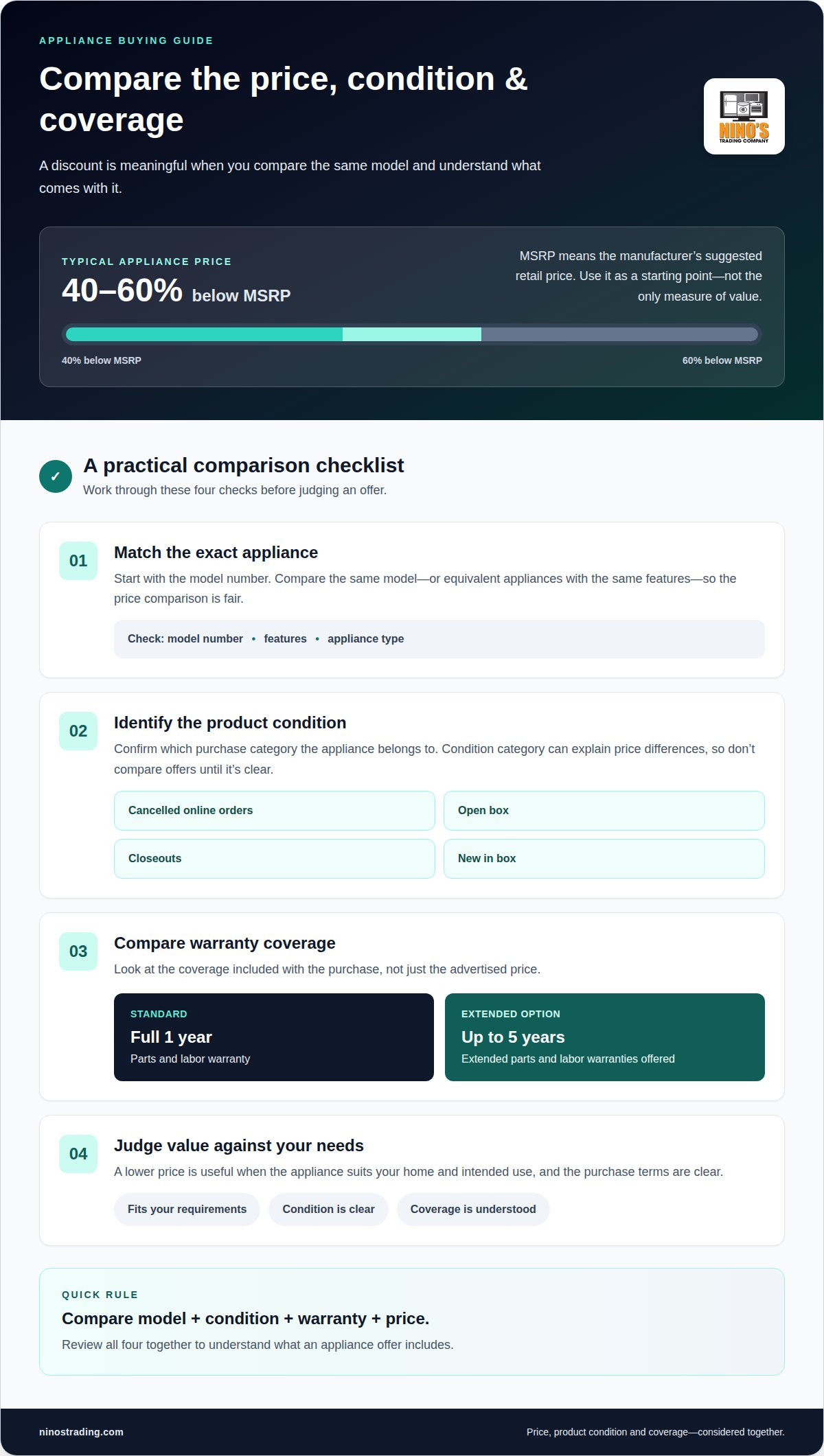
A discount is meaningful only when you compare equivalent appliances. Start with the exact model number, then compare features, condition, and included coverage. A lower advertised price may refer to a different model or product condition. For a fair comparison, use the same appliance type and model wherever possible, then decide whether it suits your home and intended use.
Appliance prices typically run 40 to 60% below MSRP. MSRP means the manufacturer’s suggested retail price. Treat that comparison as a starting point, not the only measure of value. Check the model, condition category, and warranty alongside the price. A discount is useful when the appliance meets your requirements and the terms are clear.
Product condition can explain price differences. New-in-box, open-box, closeout, and scratch-and-dent appliances are distinct purchase categories, so identify the category before comparing offers. A scratch or dent may affect appearance, while the model’s features remain central to your decision. Don’t assume every discounted item is in the same condition.
- Match the model: Compare the complete model number and appliance type.
- Identify condition: Distinguish new-in-box, open-box, closeout, and scratch-and-dent items.
- Review coverage: Read the warranty terms and understand what parts and labor coverage includes.
- Compare useful features: Focus on functions you’ll use, rather than a discount label alone.
Consider a GE range with a feature you want, such as Crisp Mode on the GE GRS500PVBB. Compare its exact model and condition with any alternative you’re considering. A different range may have a different feature set, so its lower price alone doesn’t establish equal value. Keep the feature comparison and condition assessment separate, then weigh both against the final offer.
Before deciding, note the model number, condition category, warranty terms, and listed price. This makes differences easier to spot when reviewing several appliances. If a detail affects your decision, get a clear explanation before completing the purchase. Treat the discount as one part of the comparison, not a substitute for understanding the appliance.
Refrigerators and freezers
Start your refrigerator search with the food you store and the space available. If you regularly buy fresh groceries, accessible refrigerator shelving may matter most. If you store bulk items, consider freezer capacity and organization. Measure the kitchen opening’s height, width, and depth before comparing models. Allow room for doors to open and drawers to extend. These checks help narrow the options to appliances that fit your kitchen and routine.
The GE Profile PFE28KYNFS refrigerator has a capacity of 27.7 cubic feet. Use that figure as a reference when assessing how much storage your household needs. Capacity alone doesn’t explain whether the interior layout works for your groceries. Consider where you’ll place tall containers, produce, and frozen items. Picture a typical grocery load and decide whether the shelves and compartments offer practical access.
Assess your freezer needs separately. A refrigerator’s freezer section may suit everyday frozen foods, while a standalone freezer may work better for larger or longer-term storage needs. Consider what you’ll store, how often you’ll access it, and where the appliance could fit. Someone who buys frozen meals may prioritize easy access, while a household storing bulk ingredients may need a different layout.
- Measure the location: Record the available opening and nearby clearance for doors.
- Estimate storage needs: List the groceries and frozen items you regularly keep.
- Compare capacity and layout: Use the GE Profile PFE28KYNFS as a capacity reference, then consider usable organization.
- Separate refrigerator and freezer priorities: Decide whether one appliance meets both needs or separate storage makes more sense.
Compare the model’s dimensions and interior layout with your measurements before deciding. A refrigerator that fits the opening still needs to be accessible in the kitchen. Check whether nearby counters or walls could restrict the door, then consider whether the shelves and bins fit the containers you use. These checks connect the listed capacity with your actual storage habits.
Make a short comparison sheet for each refrigerator or freezer you’re considering. Include the model name, capacity, dimensions, and the storage features that matter to you. The GE Profile PFE28KYNFS provides a named model and capacity for that comparison. Keep freezer requirements on the same sheet, but separate them from refrigerator priorities. A clear side-by-side review can reveal which appliance setup best matches your space and grocery routine.
Appliances purchase
A good appliance purchase starts with a clear need and a practical shortlist. Name the appliance type, measure the available space, and note the features you’ll use regularly. For a range, that might mean choosing a cooking setup; for a refrigerator, it could mean prioritizing storage layout. These decisions keep your search focused at a GE appliance store.
Next, compare the exact model and product condition. Options may include new-in-box appliances, open-box products, closeouts, scratch-and-dent appliances, and canceled online orders. Identify the category for the item you’re considering. With scratch-and-dent products, consider whether visible marks suit your preferences. For open-box or canceled-order items, understand the stated condition before deciding.
Warranty coverage belongs in the same comparison as the model and condition. Appliances include a full 1-year parts and labor warranty, with extended parts and labor warranties available up to 5 years. Read the coverage terms for the appliance you’re considering, then compare the standard warranty with any extended option. At a GE appliance store, this helps you assess the purchase beyond the model’s features.
- Define the need: Choose an appliance type and list the features that matter.
- Match the model: Record the full model number and compare its specifications with your requirements.
- Identify the condition: Distinguish new-in-box, open-box, closeout, scratch-and-dent, and canceled-order products.
- Review coverage: Read the parts and labor warranty terms and consider the extended option.
- Keep the records: Save the model number, purchase details, and warranty information together.
Use your comparison list before completing the purchase. If a GE range meets your cooking needs, confirm its model and condition, then review its warranty terms. If another model has different features, compare those directly rather than relying only on a discount label. A written comparison helps you weigh trade-offs and distinguish product condition from product features.
Once you’ve narrowed your options, keep the product and warranty details with your purchase records. The model number helps identify the appliance later, and the condition description records what you selected. Review the paperwork before putting it away so you can refer to it if you need product or warranty information.
Ready to put these steps into practice? Compare appliance purchase options by model, condition, and warranty coverage.
Nino's Trading Company: Refrigerators
Nino's Trading Company helps shoppers compare refrigerators and other major appliances, including washers and dryers, ranges, and TVs. If you’re choosing a refrigerator, use the earlier checklist to weigh capacity, kitchen fit, and storage layout. The inventory includes new-in-box, open-box, closeout, scratch-and-dent, and canceled online order appliances. These are not used or refurbished products.
When you’re ready to compare refrigerator options, Nino's Trading Company offers refrigerators, along with washers and dryers and ranges if you’re shopping for more than one appliance. Keep your preferred features and measurements handy to make your search more focused.
For refrigerator options and product details, visit Nino's Trading Company online.
Make Your Next Appliance Choice With Confidence
Before choosing a GE appliance store, turn your research into a short decision plan. Write down the appliance you need, the task it must handle, and the trade-off you’re willing to make. You might prioritize a particular cooking feature over a larger control panel, or choose storage layout over extra capacity. Clear priorities make comparisons more useful and keep the focus on what matters in your home.
If you’re shopping for more than one room, consider your purchases together. Nino's Trading Company sells refrigerators, washers and dryers, and TVs for several household needs. Share your priorities and the appliance categories you’re considering to take the next step.
There’s no need to make the decision complicated. Use the details you’ve gathered to identify what fits your needs, then move forward at a comfortable pace. Contact Nino's Trading Company today to discuss your appliance purchase. A thoughtful shortlist can make the next choice feel much more manageable.


