

The lowest sticker price isn’t always the best appliance deal. Prices at discount appliance stores typically run 40 to 60% below MSRP, but a smart comparison also considers the item’s condition, warranty, and model details, especially when you’re weighing an open-box option.
It makes sense to look closely before buying: a reduced price matters most when you understand what you’re getting with it. This guide will show you how to compare sale prices, assess open-box and scratch-and-dent appliances, and spot the details that can make a Whirlpool closeout worth considering.
You’ll learn what to check in a product listing, including condition, model details, and any stated warranty terms. Whether you’re considering a new-in-box appliance or a closeout, compare the full offer rather than relying on the price alone.
Key Takeaways
- Compare the exact model and condition, not just the advertised discount, to judge whether a sale price offers real value.
- Learn what to look over on open-box and scratch-and-dent appliances before deciding whether the savings suit your needs.
- Use model details and features to narrow your search for a Whirlpool closeout that fits your household.
- Review warranty coverage and return terms together so you understand what protection comes with an appliance.
- Appliances include a full 1-year parts-and-labor warranty, with extended parts-and-labor coverage available up to 5 years.
Appliance categories and brands
Discount appliance stores may carry major appliances, but selection varies by retailer and inventory. Start with the appliance you need, then compare exact model details, dimensions, condition, and listed features.
Available Appliance Types
Cooking appliances need a careful fit check. A range combines a cooking surface and oven, while a stove listing may describe a different configuration. Check the model details, dimensions, and stated power connection requirements against your kitchen. In every category, compare the model number and listed features instead of choosing by the category name alone.
Delivery and installation are not automatically included in a discounted appliance purchase. Whether a store provides either service depends on its terms and available services for that purchase. Treat delivery and installation as separate considerations from the appliance’s category, condition, and advertised price.
Discounted Brand Selection
Discounted brands can vary with the inventory available at a given store. Whirlpool is one useful example when comparing closeout deals: match the exact model number, appliance type, and features before judging the offer. A brand name alone doesn’t show whether two appliances have the same configuration or included functions.
Make a shortlist based on what you need. For a dryer, compare the controls, capacity, and stated electric or gas configuration. For a refrigerator, start with layout and dimensions. Then review the unit’s condition and any written warranty terms, since these details affect the overall value.
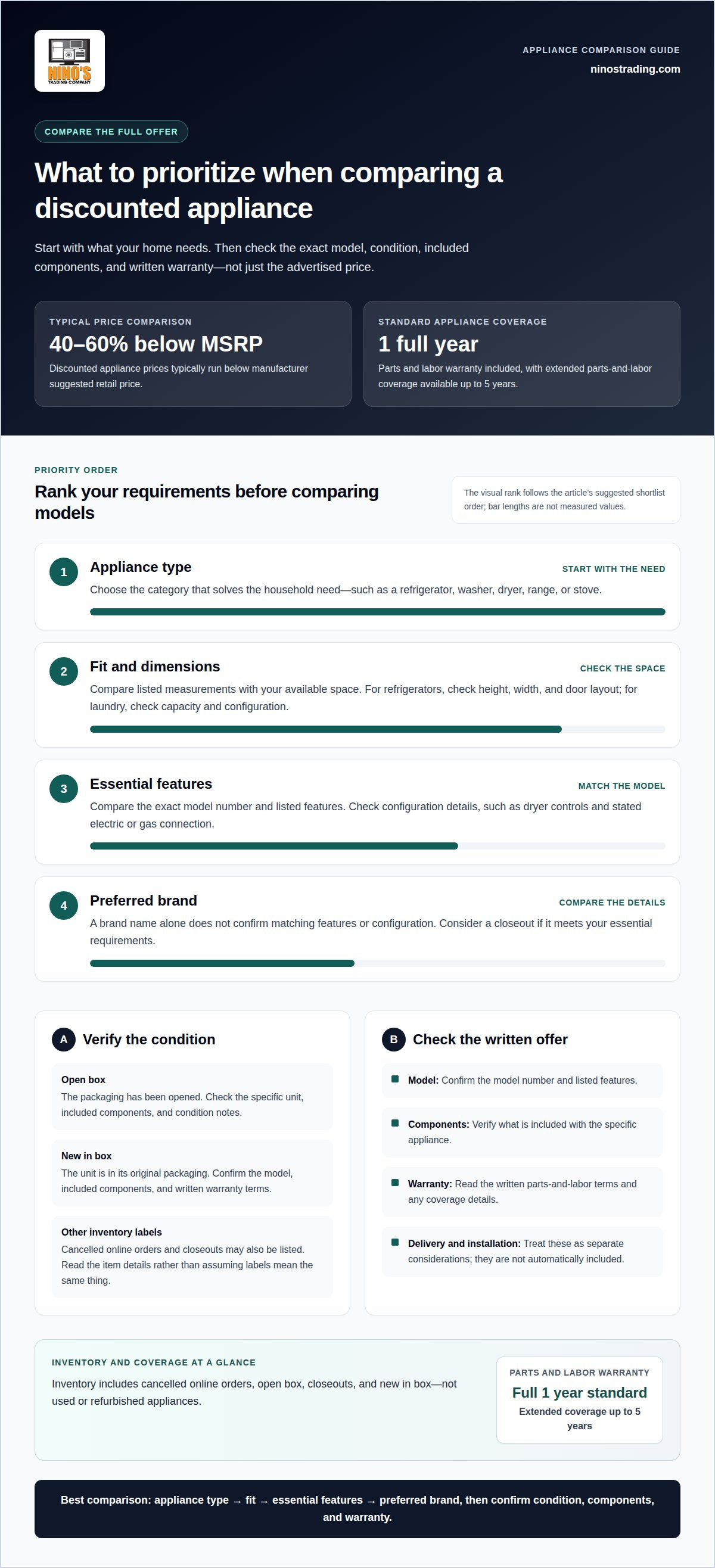
Closeout inventory may be less predictable than a full current catalog. Rank your requirements: appliance type, fit, essential features, and preferred brand. If a closeout meets your essential needs, it may be a better fit than another model selected for its brand alone. Decide which optional features are worth prioritizing.
Compare listing details side by side before choosing. Record each candidate’s brand, model number, dimensions, condition, and listed features. This makes meaningful differences easier to spot and keeps your decision focused on how the appliance will fit your home.
Open-box and scratch-and-dent appliances
Open-box and scratch-and-dent describe different considerations. Open-box means the packaging has been opened; scratch-and-dent indicates cosmetic marks. Neither label explains the full condition, included components, or warranty terms. Read the item details and inspect the specific unit before deciding.
Find out what the condition label means for the specific item. An open-box dishwasher may have opened or damaged packaging, or may have been returned. A scratch-and-dent refrigerator may have a visible mark on a panel. Packaging damage is different from a flaw on the appliance itself, so check the listing or inspect the unit.
- Inspect the exterior: Look at doors, handles, corners, and side panels for dents or scratches.
- Check the interior: For a dishwasher, review the racks, baskets, and visible surfaces.
- Match the listing: Confirm the model number and included parts match the item you’re considering.
- Review the paperwork: Read the warranty terms and any condition notes before purchase.
Cosmetic marks may matter differently depending on where the appliance will sit. A mark on a refrigerator’s visible front may be more noticeable than one on a side hidden by cabinetry. Measure the space and consider the appliance’s placement. For a dishwasher, check the door’s appearance alongside nearby cabinets.
New-in-box and open-box are different condition descriptions. A new-in-box unit is in its original packaging; an open-box unit has opened packaging. Compare the model, included components, visible condition, and written warranty terms. Don’t assume a lower-priced option includes every accessory or has the same packaging.
Manufacturer-backed coverage also needs a close read. The phrase means the manufacturer’s warranty applies to that particular appliance, subject to its written terms. Look for the warranty document, its start point, covered parts, labor coverage, and exclusions. A store’s own warranty is separate from manufacturer coverage, so identify which document applies before purchase.
For a clear comparison, record each candidate’s model number, condition label, visible marks, included components, and warranty terms. Compare new-in-box and open-box options side by side. This shows the trade-offs without treating every opened package or cosmetic mark as equivalent.
Some appliances are open-box, closeout, scratch-and-dent, cancelled online orders, or new in box, rather than used or refurbished. Each label describes a different inventory condition, so compare the specific unit and its paperwork. Browse open-box appliance options as one way to see how these condition categories fit your needs.
Refrigerators, washers, dryers, and cooking appliances
Compare appliances by purpose, fit, and model details. Refrigerator layout matters differently from a washer’s listed features. Ranges and stoves need to suit your kitchen space and connection requirements. Start with the appliance category, then narrow down the exact models.
For refrigerators, check the listed dimensions and door layout first. French-door models, for example, need enough room for doors to open. Compare shelf arrangements and storage features against the food you keep. A Whirlpool French-door refrigerator has been advertised with a 47% discount. Use its model details to compare like with like, not just the percentage.
Start a washer comparison with your laundry space and household needs. Compare each model’s listed capacity, controls, and configuration. If you’re pairing a washer with a dryer, check that both fit the room and suit the available connections. Even when buying a matching set, assess each model on its own.
Outlet washers and dryers may differ in condition and model. The word “outlet” does not tell you an item’s condition or what it includes. Check the listing for its model number, condition, included components, and warranty terms. Compare the washer and dryer separately, even if they’re shown together.
- Refrigerators: Match dimensions, door layout, and storage arrangement to your kitchen.
- Washers: Compare model details and fit with your laundry space.
- Dryers: Check the listed power type and connection requirements.
- Ranges and stoves: Compare dimensions, cooking setup, and stated power requirements.
Check fit before comparing cooking features. A range and a stove listing may describe different configurations, so read the model details. Compare the stated cooking-surface and oven information, and confirm the listed dimensions suit your available space.
Record each model number and its key details to keep comparisons clear. A simple table can include category, dimensions, condition, configuration, and warranty terms. For refrigerators, compare door layout and size before weighing optional features. This keeps the discount from distracting you from whether the appliance fits.
Separate the closeout offer from the model comparison. Consider a closeout when its exact features and dimensions meet your needs, then compare it with other options using the same criteria. The right choice is the model that fits your home and priorities.
Sale prices and retail-price comparisons
A sale label alone doesn’t show whether an appliance is good value. Compare the same model and condition, and review the terms included with the offer.
Discounted Appliance Prices
Start with the model number, not the headline price. Two refrigerators may look similar but have different layouts, features, or included components. Record the model number, condition, and listed price for each candidate to make a more useful comparison.
Compare the listed price with any stated retail reference, checking that both apply to the same model and condition. A new-in-box unit and an open-box unit are not direct comparisons, even if their model numbers match. Condition and included components also affect the value of the offer.
Make a short comparison for each candidate. Include the appliance type, model number, condition, listed features, warranty terms, and price. Compare dryers only after checking their configurations and included terms. That way, a discount won’t distract you from important differences.
Retail-Price Comparisons
A retail-price reference is useful only when it describes the exact appliance. Compare the model number and configuration, and check whether the reference applies to a new or open-box unit. If the listing compares different models, the percentage reduction may not show the value of the purchase.
Review the full offer, not just a crossed-out price. A washer may differ from another in condition, included components, or warranty terms. Note these details alongside the price, then decide whether the savings are worth any differences that matter to you.
Retail prices can change, and listings may show different reference amounts. Use current listing details and compare equivalent models. An older advertised price is not a direct match for a different configuration. A side-by-side comparison can make the differences clear.
Price Matching
Price matching is a retailer policy, not a standard feature of every sale. The terms may specify which offers qualify and which product details must match, including model, condition, and sale timing. Read the stated policy before factoring a possible price match into your budget.
Keep the model number, condition, and price together when comparing listings. A new model should not be treated as identical to an open-box listing, even if the model numbers match. Comparing like with like makes the price difference clearer, whether or not a price-matching policy applies.
Use this simple sequence to review an offer:
- Match the exact model and configuration.
- Compare condition and included components.
- Review warranty terms alongside the sale price.
- Read the retailer’s price-matching conditions, if relevant.
This approach helps you assess discounted appliance prices against the full offer. The model, condition, warranty terms, and any relevant retailer policy clarify what the price includes.
What warranties and return policies do discount appliance stores offer?
Warranty coverage and return terms are separate parts of an appliance purchase. Read the written terms for the exact model before paying, especially for open-box or scratch-and-dent items. The warranty explains coverage for repairs; the return policy explains the conditions for returning an item.
Check the warranty period and what it covers. Look for details about parts and labor, as well as exclusions or maintenance conditions. A washer warranty may explain component coverage separately from the service process. Keep the written terms with the receipt and model details.
Identify who provides the warranty. A manufacturer warranty and a store-provided warranty may have different terms and claim steps. For an open-box appliance, read the applicable document and note its start date, coverage, and instructions for requesting service.
Extended coverage is a separate option. Compare its term, covered parts, labor, and exclusions with the standard warranty. Check whether the plan adds coverage or extends similar protections. Its written terms matter more than the label.
Read the return policy just as carefully. Check the return conditions, any deadline, and how the retailer handles an item that arrives damaged or differs from its listing. Terms may vary for new-in-box and open-box items. Keep the listing and purchase records so you can refer to the details provided.
- Before purchase: Save the model number, condition description, warranty, and return policy.
- At delivery or pickup: Compare the appliance with its listing and note visible damage.
- After purchase: Keep the receipt and warranty paperwork in one place.
For scratch-and-dent appliances, compare the stated cosmetic condition with the return terms. A mark described in the listing may be treated differently from another issue under the policy. Review the notes for the specific unit alongside the written terms rather than relying on a broad label.
Policies vary among discount appliance stores. Compare coverage, exclusions, claim steps, return conditions, and deadlines. If you’re reviewing terms from different retailers, make sure the listings describe the same model and condition.
Before choosing among discount appliance stores, review the appliance options and warranty coverage alongside the written terms.
Nino's Trading Company: Refrigerators
Nino's Trading Company is a practical next step if you’re comparing refrigerators and want to consider more than one appliance category. Its offerings include refrigerators, washers and dryers, TVs, and ranges, with options such as closeouts, open-box, scratch-and-dent, cancelled online orders, and new-in-box appliances. The inventory is not used or refurbished.
Each appliance includes a full 1-year parts-and-labor warranty, with extended parts-and-labor coverage available up to 5 years. If you’re weighing a refrigerator against a washer, dryer, or range, compare the model details, condition, and warranty terms together. That keeps the decision grounded in what fits your home and budget.
Explore Nino's Trading Company online to review appliance options.
Make Your Next Appliance Choice With Confidence
Before browsing discount appliance stores, decide which requirements are essential and which features are flexible. Note the available space, the appliance’s main purpose, and any details you’re willing to trade off. This shortlist keeps your search focused on your household’s needs.
Nino's Trading Company offers refrigerators, washers and dryers, and TVs, giving you options to consider as you plan your next appliance purchase. Use your shortlist to compare suitable models and decide which category deserves attention first. A clear starting point can make the selection process feel more manageable.
Choose the appliance you need most, then take the next step at Nino's Trading Company. With your priorities in hand, you can explore options at your own pace and make a decision that feels right for your home.
Frequently Asked Questions
Why Buy Open-Box?
Open-box can offer another way to compare appliances when sealed packaging isn’t essential to you. Some discount appliance stores include open-box units among their inventory, so compare the individual item’s condition and included components with a new-in-box alternative. For example, a television with opened packaging may suit your needs if its listed model and included parts match what you want. The specific unit matters more than the label.
What types of appliances do discount stores sell?
Discount appliance stores may sell refrigerators, washers, dryers, ranges, stoves, and dishwashers, and some also carry TVs. Selection varies, so start with the category you need and compare exact models. If you need both laundry appliances, treat the washer and dryer separately unless the listing clearly identifies them as a pair.
How much can I save buying appliances at discount stores?
Savings depend on the specific appliance, its condition, and the reference price used. There is no single saving that applies to every model. Compare the same model and configuration, then account for included components and warranty terms. Focus on how well the appliance fits your needs, not the discount label alone.
How do prices compare with major retailers?
Compare equivalent models rather than relying on the retailer’s name. A major retailer’s listing may describe a different configuration or condition than an outlet listing. Match the model number first, then compare what comes with the appliance and the applicable terms. This gives you a more useful price comparison than placing two similar-looking refrigerators side by side without checking their exact details.
Do discount appliance stores sell scratch-and-dent or open-box appliances?
Some discount appliance stores carry scratch-and-dent, open-box, closeout, cancelled online order, and new-in-box appliances. These labels describe different inventory conditions. Scratch-and-dent refers to cosmetic marks, while open-box means the packaging has been opened. Read the item details to understand the condition of the specific appliance.
What should I check before buying a discounted appliance?
Check the model number, dimensions, condition, included components, warranty, and return terms. Consider how the appliance will reach its intended room, too. A refrigerator may fit the kitchen opening but not a narrow doorway or hallway. Measure both the installation space and the route into your home before buying.
Are financing and price-matching available at discount appliance stores?
Financing and price matching depend on each retailer’s policies. Read the stated terms for eligibility and qualifying products before including either option in your comparison. For price matching, use an offer for the same model and condition, since a similar-looking appliance may have different features or inventory status. Consider financing terms separately from the item’s price when evaluating the full purchase.


