

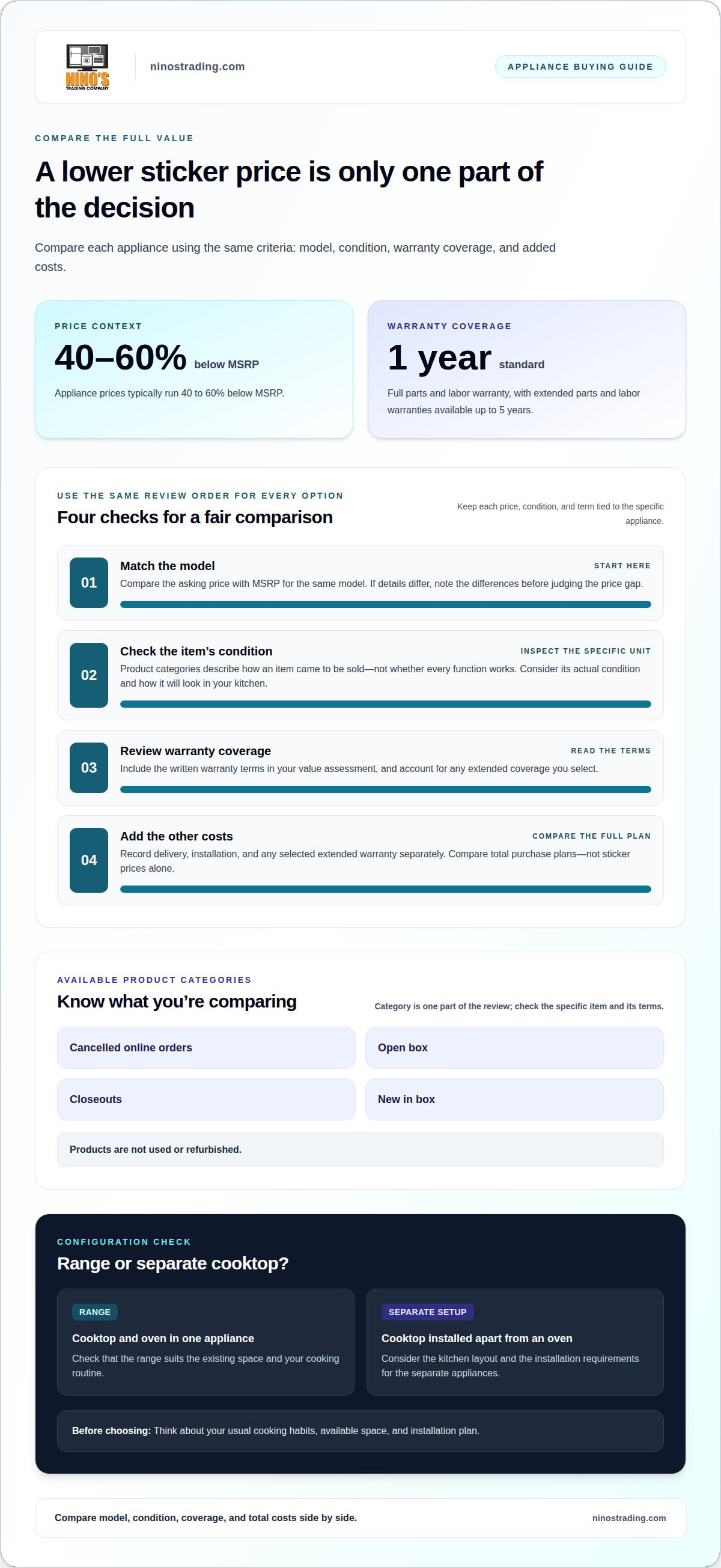
The trade-off with scratch and dent ranges in Fayetteville is cosmetic damage: a visible mark may come with a lower price, while you still need to make sure the range works as expected. Appliance prices typically run 40 to 60% below MSRP, and appliances come with a full one-year parts and labor warranty.
A lower price is appealing, but it’s reasonable to want clarity about what caused the damage, how the range performs, and what the warranty covers. This guide explains how to weigh savings against condition, compare range and cooktop options, and review warranty terms before choosing. You’ll also find practical checks to help decide whether a particular appliance suits your kitchen and budget.
Key Takeaways
- Scratch-and-dent appliances can offer value, but the type and location of cosmetic damage matter when deciding whether a range suits your kitchen.
- Compare range and cooktop configurations against your available space and cooking needs before choosing a model.
- Test the appliance’s functions and review the warranty coverage so you understand what protection comes with your purchase.
- Open-box, closeout, cancelled-order, and new-in-box appliances are alternatives to used or refurbished products.
- Nino’s Trading Company offers ranges with a full one-year parts and labor warranty, plus extended warranty options for additional coverage.
Why Scratch and Dent Appliances?
A scratch or dent describes an appliance’s appearance, not how it works. When comparing scratch-and-dent ranges in Fayetteville, Arkansas, look at the cause and location of each mark, then assess the range’s functions. A dent on a side panel beside a cabinet may be less visible than damage on the front. The condition of the individual appliance matters more than its category label.
In Fayetteville, Arkansas, inventory depends on what enters the local market. Scratch-and-dent appliances may have handling or packaging damage, while open-box goods, cancelled online orders, closeouts, and new-in-box products have different purchase histories. These labels describe how an item came to be sold, not whether every function works. Review the specific range’s condition and available operating checks before comparing it with another option.
Inspect appliances in a consistent order. Start with the exterior, then examine the door, controls, cooktop, and oven interior. Note whether a scratch is on a visible front surface or a side hidden by cabinetry. Compare the same areas on another range, and consider whether the damage affects fit or everyday use. A step-by-step inspection helps keep a cosmetic flaw from distracting you from the appliance’s overall condition.
- Condition: Find each scratch, dent, or packaging mark and note its location.
- Operation: Observe the controls and functions that can be demonstrated.
- Fit: Measure the kitchen opening and the route into the room.
- Terms: Review the appliance’s warranty and delivery details.
Delivery and professional installation require separate planning. Measure the route from the entrance to the kitchen, including narrow doorways and tight turns. A range may fit its kitchen opening but be difficult to move through a hallway. Consider where the appliance will sit and whether the home’s existing connections suit the selected model. Plan installation around the home and appliance, not appearance alone.
For a Fayetteville, Arkansas home, prepare the receiving area before delivery. Clear the path and decide where the range will go. If replacing an existing appliance, plan how it will be moved out and make room for the new one. These steps help you assess practical fit alongside cosmetic condition, function, and the purchase terms.
Potential savings
A lower sticker price matters only if the range fits your budget and needs. Compare the appliance’s asking price with its suggested retail price for the same model, rather than using a different range as your reference. If model details differ, note those differences before judging the price gap. This keeps the comparison tied to the appliance you might actually buy, not a broad category estimate.
Next, decide whether the cosmetic condition is an acceptable trade-off. A small mark on a side that will sit beside cabinetry may affect your decision differently from a visible blemish on the front. Consider how the range will look in its planned position and whether the flaw would continue to bother you. The value of a discount depends partly on how much that particular condition matters in your kitchen.
Build a full purchase comparison before choosing. Record the appliance price, delivery charge, installation expense, and any selected extended warranty separately. These costs can affect how much room remains in your household budget. If one range requires additional installation work while another does not, compare the total purchase plans rather than the sticker prices alone. Keep each amount tied to its specific option.
- Model: Match the model number, or clearly note differences between options.
- Condition: Consider the flaw’s location and its visibility in your kitchen.
- Coverage: Include the written warranty terms in your value assessment.
- Added costs: Account for delivery and installation before setting your budget.
Imagine comparing two ranges with different cosmetic marks and warranty terms. The lowest asking price may not be the best fit if its flaw is prominent or its coverage doesn’t meet your preferences. Weigh the savings against the range’s condition, functions, and included terms. This makes the trade-off clear without treating the discount as the only reason to choose one appliance.
Compare purchase categories, too. An open-box range, a cancelled online order, a closeout, and a new-in-box appliance can have different histories and exterior conditions. A shopper who values an untouched exterior may prefer one category, while someone comfortable with a visible cosmetic mark may consider another. The item’s actual condition and terms remain central to the decision.
Before deciding, write down each option’s model, asking price, condition, coverage, and additional costs. Use the same criteria for every range, then identify which trade-off matters most to your household. To review range choices, compare the available range options against your kitchen requirements and budget.
Ranges and cooktops
A range combines a cooktop and oven in one appliance, while a cooktop is installed separately from an oven. That distinction affects kitchen layout, replacement choices, and installation planning. Replacing a freestanding range usually means choosing another range that suits the existing space. A separate cooktop creates a different setup, with its own installation requirements. Decide which arrangement fits your kitchen before comparing scratch-and-dent options.
Next, match the appliance type to your household’s cooking habits. A range may be practical if you regularly use both the oven and surface burners. A separate cooktop may suit a kitchen designed around separate cooking appliances. Think through ordinary meals: frequent oven use, several pots in rotation, or mostly stovetop cooking can each point toward a different configuration. Choose the arrangement that suits your routine and kitchen layout.
Check the existing opening and appliance placement before selecting a range. Measure the space and note nearby counters, cabinets, and the route into the kitchen. For a separate cooktop, consider the countertop opening and oven location as distinct parts of the plan. Also identify the home’s existing connection type. The appliance must suit that setup, so plan installation around the specific model rather than assumptions based on appearance.
- Range: Compare the cooktop and oven together as one appliance.
- Separate cooktop: Account for its countertop location and separate oven arrangement.
- Kitchen fit: Measure the opening, nearby surfaces, and delivery path.
- Cosmetic condition: Look closely at the control area, front, sides, and cooking surface.
Cosmetic damage deserves extra attention on a range because its location affects daily visibility and use. A mark on a side hidden beside cabinetry may be less noticeable than a dent across the front. On a cooktop, examine the cooking surface and controls closely. Look at each appliance in the position it will occupy, then decide whether the flaw affects its appearance, use, or fit in your kitchen.
During an in-person comparison, operate the controls and observe available functions rather than judging by finish alone. Check that doors open and close as expected, and examine the oven interior and cooktop area. For two similar ranges, compare damage location, configuration, condition, and warranty terms side by side. A simple written comparison makes trade-offs easier to see and keeps a cosmetic discount from overshadowing the features that matter most.
Bring your measurements and kitchen layout into the selection process. A range that looks suitable on the showroom floor may not fit the available opening or delivery route. Matching the appliance type, connection, condition, and space requirements gives you a clearer basis for choosing between a range and a separate cooktop.
Warranty and functionality considerations
Cosmetic condition and performance are separate questions. A range can have a visible mark while its controls and cooking functions operate normally. Examine the appliance’s damage history, then focus your function check on the affected area. For example, a dent near the control panel makes those controls worth close attention. Base your observations on the specific range rather than assuming every appliance with the same label has the same condition.
Read the written warranty before purchase and identify its start date, coverage period, and claim process. Look for the parts and labor terms, along with any exclusions or conditions that affect coverage. Ask how to submit a service request and what documents you’ll need. Keep the warranty paperwork and receipt together, since both may help explain the appliance and the terms that apply.
Test what can be demonstrated in the showroom. Operate the control panel, check that the oven door opens and closes smoothly, and review the interior and cooking surface. Note which functions were demonstrated and which were not. A demonstration can provide useful information about the range’s current operation, while the written warranty explains coverage if a covered problem arises later. Neither replaces the other.
- Damage record: Note the location and description of each visible mark.
- Function check: Record which controls and functions were demonstrated.
- Warranty terms: Identify the covered parts, labor, exclusions, and claim steps.
- Purchase documents: Keep the receipt and warranty paperwork together.
Imagine two ranges with similar exterior marks. One has a clear demonstration and easy-to-follow warranty documents; the other has less detail about its functions and coverage. The difference is the information available to help you decide, not proof that either range will or won’t develop a problem. Base your comparison on the appliance’s observed condition and the written terms for that purchase.
Damage history can help focus your inspection. If a mark is close to a control, check that control during the demonstration. If the damage is on a door, examine how it opens and closes. Then compare your observations with the written warranty, especially any terms relevant to the affected area. This connects visible condition with practical checks without treating cosmetic damage as evidence of an operating fault.
Before completing the purchase, make sure you understand the warranty documents and have a record of the functions demonstrated. Note any points you want clarified in writing, and keep the response with your purchase records. Clear documentation gives you a practical reference for the range’s condition, coverage terms, and steps to follow if you need service.
Fayetteville area
Fayetteville, Arkansas is the location to keep in mind when comparing appliance options and planning delivery. A city name alone doesn’t establish whether a range can reach your home or fit through its entrance. Start with your full delivery address, then consider the route from the drop-off point to the kitchen. A house with a direct entrance may have different access needs from an apartment with shared doors or stairs.
Before arranging delivery, measure the kitchen opening and the path into the room. Include doorway widths, tight turns, and any steps between the entrance and kitchen. A range may fit its designated space but still be difficult to move through a narrow hallway. Keep your measurements together so you can compare them with the appliance’s dimensions and discuss access requirements before arranging delivery.
Fayetteville shoppers should also distinguish Arkansas from Fayetteville, North Carolina when reading appliance information. A store location, delivery route, or instruction tied to North Carolina doesn’t describe a trip in Arkansas. Use the destination address and state as the reference point for local arrangements. This location check helps prevent confusion when an online result or direction mentions the same city name elsewhere.
Plan the handoff around the kitchen, not just the front door. Clear the path, remove obstacles, and decide where the existing range will go before the new appliance arrives. If replacing a range, consider how the old unit will be moved out and whether the kitchen is ready for the new one. For a separate cooktop, plan around the countertop opening and oven location as two distinct placement points.
- Address: Use the Fayetteville, Arkansas destination for delivery planning.
- Route: Measure entrances, hallways, turns, and steps along the appliance’s path.
- Placement: Prepare the range location and clear nearby obstacles.
- Installation: Account for the home’s existing connection and the appliance’s requirements.
Delivery and installation are related, but they’re separate planning steps. Delivery gets the appliance to its intended location; installation addresses setting it up for use. A clear route may solve access concerns without answering questions about the home’s connection or installation needs. Keep those plans distinct, and have the appliance details and kitchen measurements available when arranging each step.
Local planning also means considering the receiving space and replacement timing. If the kitchen is being remodeled, coordinate the range’s arrival with cabinet and countertop work. If the current appliance is already out, prepare a clear landing area before delivery. These details help the arrival process fit your home instead of creating extra moving or storage work.
Use your Fayetteville, Arkansas address, measurements, and installation plan to organize the next steps. Explore range options and consider how each choice fits your kitchen and delivery route.
Nino's Trading Company: Ranges
Nino's Trading Company sells ranges for shoppers comparing cosmetic condition, configuration, and kitchen fit. Its appliance options include scratch-and-dent, open-box, closeout, cancelled online order, and new-in-box products. These categories give you different conditions and purchase histories to consider when choosing a range.
Review the details of each range alongside your kitchen measurements and cooking priorities. Nino's Trading Company also sells refrigerators, washers and dryers, and TVs, which may be useful if you’re planning a broader appliance or electronics purchase.
Contact Nino's Trading Company to discuss range options and decide which details matter most for your home.
Make Your Range Choice With Confidence
Your next step is to turn your kitchen priorities into a short decision list. Note which features matter most, what cosmetic flaws you’re comfortable seeing, and what questions remain about a specific range. This gives you a practical way to compare options without letting a discount or finish alone make the decision.
For shoppers considering scratch-and-dent ranges in Fayetteville, the right choice is the one that fits the space, cooking routine, and your comfort with the appliance’s condition. You can also consider other household needs, including refrigerators, washers and dryers, or TVs. A clear list helps keep decisions focused on what your home needs.
When you’re ready to take the next step, contact Nino's Trading Company to discuss range options and your priorities. A thoughtful comparison can make the decision feel simpler, and help you choose with confidence.
Frequently Asked Questions
What’s the downside?
The main downside is accepting a visible cosmetic flaw in exchange for a lower price. For shoppers considering scratch-and-dent ranges in Fayetteville, a mark on the front may remain noticeable every day, while one on a hidden side may matter less. The appliance’s history and condition also vary by item, so the category label alone can’t tell you what happened or how the range was handled.
Where can I buy scratch-and-dent ranges in Fayetteville?
Fayetteville, Arkansas is within Nino’s Trading Company’s service area. The company serves communities across Arkansas and Oklahoma, including Springdale, Rogers, Bentonville, Little Rock, and Fort Smith in Arkansas. Its Oklahoma service area includes Tulsa, Oklahoma City, Broken Arrow, Yukon, Mustang, and Edmond. Use your Arkansas delivery address when considering local options and planning the range’s route into your home.
Which Fayetteville appliance stores sell scratch-and-dent or open-box ranges?
Nino’s Trading Company sells ranges, including scratch-and-dent and open-box appliances, to customers in Fayetteville, Arkansas. It also serves Springdale, Rogers, Bentonville, Little Rock, and Fort Smith, as well as Oklahoma communities such as Tulsa and Oklahoma City. Consider the retailer’s regional coverage separately from a particular range’s condition, since each appliance should be assessed on its own details.
What scratch-and-dent range brands and models are available near Fayetteville?
Brand and model choices depend on the range you’re considering. Compare the exact model number on the appliance label with its product details, rather than relying on the brand name alone. Two ranges from one brand can differ in configuration and features. Use model information to compare the unit’s condition, operating functions, and warranty terms, then decide whether that specific option suits your kitchen.
How much do scratch-and-dent ranges cost in Fayetteville?
There isn’t one price for every scratch-and-dent range. The model, its condition, and the difference between its suggested retail price and asking price all affect the comparison. Check the exact range’s price and model details, then account for any separate delivery or installation costs in your household budget. Comparing the same model gives you a clearer picture than comparing unrelated ranges.
Are scratch-and-dent ranges in Fayetteville discounted compared with new ranges?
Yes, scratch-and-dent ranges can cost less than comparable new ranges, with cosmetic condition forming part of the trade-off. Compare the same model where possible, then consider whether the location and appearance of its damage are acceptable in your kitchen. A lower price is most useful when the range’s configuration, functions, and condition suit your household’s needs.
Do Fayetteville scratch-and-dent stores offer delivery and installation?
Delivery and installation are separate parts of a range purchase, so don’t assume one includes the other. Delivery concerns getting the appliance to its intended location; installation involves setting it up for use. Measure the route into your kitchen and prepare the range space before scheduling either step. Keep the appliance’s model details and home connection information available during planning.
What warranties and return policies apply to scratch-and-dent ranges in Fayetteville?
Warranty coverage and return eligibility are separate terms. Read the written warranty to understand what it covers and how to request service, then review the return terms separately for deadlines, condition expectations, and exclusions. Keep the receipt and both documents together. A warranty doesn’t itself establish a right to return, exchange, or refund, so use the terms for the specific purchase when deciding.


