

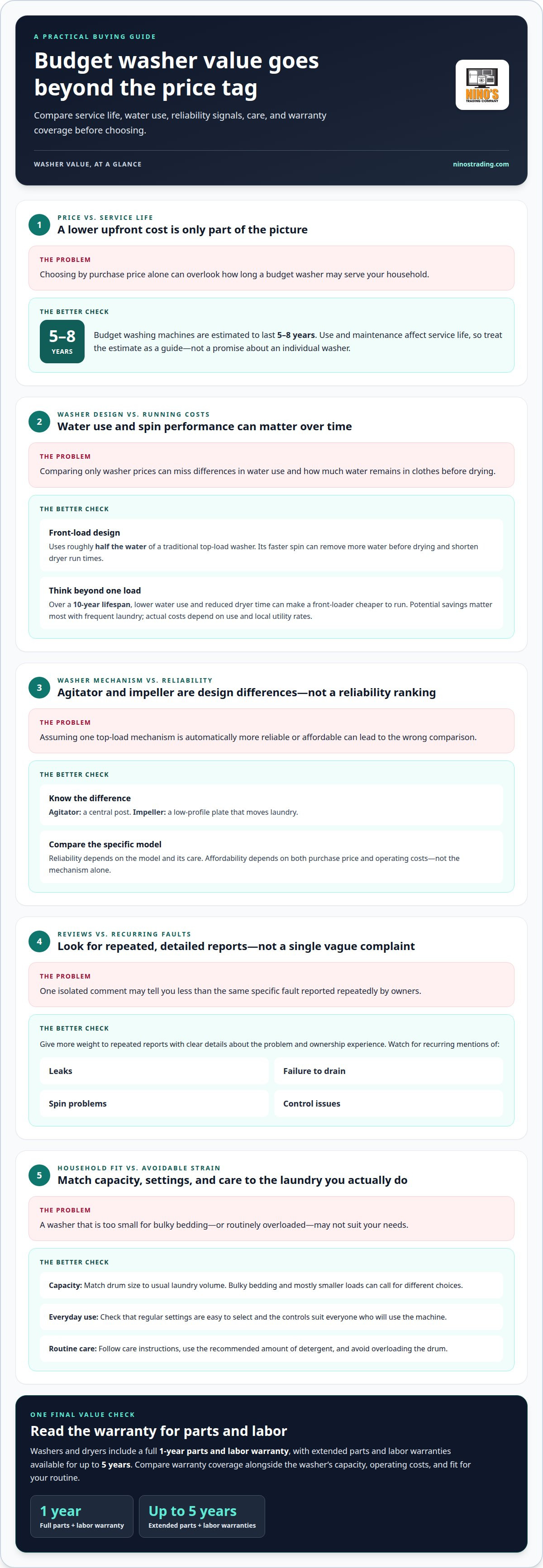
The cheapest washer isn’t always the best value over time. Budget washing machines typically last 5-8 years, depending on use and maintenance, so it pays to look beyond the price tag when choosing reliable washing machines on a budget.
It’s reasonable to expect an affordable washer to clean well and hold up to regular laundry, but a lower price can involve trade-offs in capacity, features, or efficiency. This guide explains what to compare, from durability and washing performance to energy use and warranty coverage, so you can focus on what matters for your household. You’ll also learn to assess everyday value without assuming extra features mean better performance. The goal is to find reliable washing machines on a budget that fit your laundry needs, with a clear understanding of what you’re buying.
Key Takeaways
- Compare front-load and top-load designs by water use and how each fits your laundry routine.
- Look beyond cycle counts: capacity, cycle length, and fabric care all affect everyday performance.
- Use estimated energy and water use to compare operating costs, not just the washer’s purchase price.
- Read warranty coverage for both parts and labor, and consider whether extended coverage suits your needs.
- Nino's Trading Company offers washers and dryers with a full 1-year parts and labor warranty, plus extended parts and labor warranties up to 5 years.
1. Are Affordable Washing Machines Durable?
Finding reliable washing machines on a budget starts with separating price from expected service life. Budget washing machines are estimated to last 5-8 years, depending on use and maintenance. A broader estimate for an affordable washer and dryer pair is eight and 12 years with routine care. These figures describe different buying situations, so treat them as guides rather than promises about an individual washer.
Top-load and front-load washers have different designs. Top-load models are loaded from above, while front-load models use a side door and rotate clothes through the water. Among top-load washers, an agitator is a central post; an impeller is a low-profile plate that moves laundry. Compare the design with your household’s usual loads and preferred settings, rather than choosing by category alone.
Front-load washers use roughly half the water of traditional top-load washers. Their faster spin can also remove more water before drying, shortening dryer run times. Over a 10-year lifespan, lower water use and reduced dryer time can make a front-loader cheaper to run. That potential saving matters most when you do frequent laundry, though actual operating costs depend on use and local utility rates.
Neither agitator nor impeller top-load washers are automatically more reliable or affordable. Reliability depends on the specific model and its care, while affordability depends on both purchase price and operating costs. Compare those factors instead of assuming one mechanism lasts longer.
To spot recurring reliability problems in reviews, look for the same fault reported repeatedly, such as leaks, failure to drain, spin problems, or control issues. Give more weight to detailed accounts of the problem and ownership experience than to a vague complaint. For example, repeated reports of a Whirlpool washer failing to complete its spin cycle deserve closer attention than one isolated comment about noise.
Before choosing a budget washer, make a simple comparison: note the washer type, water-use information, capacity, and warranty terms. Match the capacity to your usual laundry. A household washing bulky bedding has different needs from one washing mostly smaller loads. Check that your regular settings are easy to select and the controls suit everyone who will use the machine.
Routine care also affects durability. Follow the washer’s care instructions, use the recommended amount of detergent, and avoid overloading the drum, which can strain the machine during a cycle. A washer that fits your laundry volume and is maintained as directed is a more practical choice than one selected on low upfront cost alone.
2. What Are the Best Budget Washing Machines That Deliver High Performance?
A useful budget comparison considers the washer and dryer together, not the washer alone. There is no single total for a new set that includes delivery and installation: those charges depend on the models, delivery arrangements, and installation needs. Compare the complete checkout total and included services before deciding what fits your budget.
Upfront price is only one part of laundry value. Capacity affects how much clothing fits in each load, while electricity and water use shape ongoing expenses. A compact washer may suit a smaller household, but its capacity could mean more frequent loads. For a larger household, compare drum size with typical laundry volume so the purchase price reflects how the machine will be used.
Promotions can change a model’s value without changing its features. Consumer Reports lists July, September, and November as good times to buy washing machines. Seasonal sales may make a higher-capacity or more efficient option worth considering, but a discount alone doesn’t show whether the washer suits your routine. Compare the offer with the model’s capacity, settings, and warranty terms.
To compare sale prices fairly, use the same checklist for each washer. Record the complete purchase total, including delivery and installation. Then compare capacity and expected electricity and water use, and see whether useful settings are included or require a more expensive model. This keeps a low advertised price from overshadowing what matters for your laundry.
Are refurbished or scratch-and-dent washing machines a good budget option? Scratch-and-dent appliances can be worth considering if cosmetic marks are acceptable and the warranty coverage and operating condition meet your needs. Refurbished machines are a different category, so don’t treat them as equivalent to new or open-box appliances when comparing condition and coverage.
For example, a household washing bulky bedding may get more value from a larger-capacity washer than from extra cycle choices. Someone with limited laundry space may prioritize compact dimensions instead. These trade-offs explain why the best budget washer isn’t necessarily the lowest-priced model or the one with the longest feature list.
Consider the washer and dryer as a pair, too. A washer’s high-spin setting can affect how wet clothes are when they go into the dryer, while the dryer’s capacity should accommodate the loads you wash. Compare both appliances, then weigh the complete purchase against capacity, operating expenses, and warranty coverage. This gives you a practical basis for judging value beyond the promotion alone.
3. What’s the difference between a cheap and an expensive washing machine?
The gap often shows up in cycle choices, controls, and convenience rather than basic washing ability. High-efficiency top-load cycles typically run 70 to 105 minutes, while a Quick Wash cycle may take 15 or 20 minutes. Some affordable models offer quick cycles lasting 15-30 minutes, but those shorter settings suit lightly soiled clothes better than a heavily stained load.
Water use also varies by washer design and cycle. Traditional top-load washing machines can use upwards of 40 gallons per cycle, while high-efficiency washers use 20 to 66 percent less water. The exact use depends on the washer and selected settings. For a practical comparison, look at the model’s water-use information and consider how often you run full loads.
Fabric care depends on wash action, load size, and the selected cycle, not just the machine’s price. A strong cycle may suit durable towels, while delicate fabrics call for a gentler setting. Overloading can prevent clothes from moving freely through the wash. Match the cycle to the fabric label and avoid using a heavy-duty setting for every load.
Feature counts can differ substantially. Some mid-budget washing machines have 6-8 wash programs, while the Samsung Super Speed Top-Load Washer has 17 cycles. More options can help households handle varied laundry, but extra cycles matter only if they solve a regular need. Check for settings you’ll use, such as delicate, bulky-item, or quick wash, rather than choosing by count alone.
Specialty cycles can handle particular tasks, including sanitizing or stain removal. A sanitize setting may use higher temperatures, so check garment care instructions before selecting it. For everyday laundry, a normal cycle and suitable detergent may be enough. Compare cycle descriptions across models, because similar names can have different purposes and time requirements.
Smart features are another common difference in price. Connected models may offer app-based controls or cycle notifications, while simpler washers use buttons or a dial. A smart feature is useful when it makes a real task easier, but it doesn’t replace suitable capacity or wash settings. Choose controls that feel easy for everyone in the household to use.
To assess value, list the jobs your washer handles most often, such as work clothes, bedding, or stain-prone children’s clothes. Then compare cycle options, water use, and controls across brands. Pay for specialty settings or connected features only when they suit your routine. This step-by-step comparison helps separate useful upgrades from features that add complexity without improving everyday laundry.
4. Energy use and estimated operating costs
A washer’s purchase price doesn’t show what it will use during regular laundry. Compare estimated annual electricity use and water consumption, then consider how often your household runs loads. A model with lower electricity use may still use more water, so check both measures instead of relying on one efficiency label or feature.
For example, the Whirlpool WFW4720RW is estimated to use 140 kWh of electricity per year and 4,248 gallons of water per year. The Electrolux ELFW7738A is estimated at 74 kWh of electricity per year and 3,452 gallons of water per year. Those figures illustrate why it’s useful to compare both resources across models, not just the washer type.
Water use also differs between high-efficiency washers and traditional designs. High-efficiency washing machines use 20 to 66 percent less water, while traditional top-load washers can use upwards of 40 gallons per cycle. Actual consumption depends on the washer and its settings. An agitator or impeller doesn’t tell the whole story, so compare the model’s listed use alongside its cleaning performance.
Annual electricity estimates offer another useful comparison. These are energy estimates, not total operating costs: water, detergent, and dryer use also affect what laundry costs at home.
Energy Star-certified appliances use 25 percent less energy than standard models. That can help narrow options during buying, but the best comparison still depends on household habits. Frequent loads make annual energy and water use more relevant; occasional washing makes capacity, cycle choices, and the machine’s fit just as important.
To compare two washers, write down each model’s yearly electricity estimate, annual water use, and capacity. Then consider your usual load size and whether you wash full loads. A smaller load may not use resources in direct proportion to its size, so don’t assume half a load means half the energy or water. Follow the washer’s instructions for load size and settings.
Lower water use can also affect drying. Front-load washers spin faster and remove more water before clothes go into the dryer, which can shorten dryer run times. This matters when comparing the combined energy use of laundry appliances, rather than judging the washer alone. A lower washer estimate is most useful when the model also suits your regular cleaning needs.
Use the figures to compare models, not to predict a specific utility bill. Local rates, cycle selection, load size, and household laundry frequency all affect actual expenses. If two washers meet your capacity and cleaning needs, comparing annual electricity and water estimates can help identify which better fits your operating-cost priorities.
5. Warranty coverage
A washer’s warranty helps define what support comes with the purchase, but the length alone doesn’t explain every detail. Every appliance includes a full 1-year parts and labor warranty, with extended parts and labor warranties available up to 5 years. That coverage gives buyers a clear starting point when comparing appliances and estimating how long protection may continue.
Parts and labor cover different aspects of a repair. Parts coverage concerns eligible components, while labor coverage concerns the work involved in an eligible repair. Read the warranty terms to understand what each includes, how to begin a claim, and which documents you need. Keep the purchase record and warranty information together for easy reference.
Extended coverage can provide a longer protection period, but compare its terms with the standard warranty before choosing it. Review the coverage duration, included parts and labor, and claim process. A longer period doesn’t automatically mean broader coverage, so focus on the written terms rather than duration alone.
For a washer and dryer set, review coverage for each appliance instead of assuming both have identical terms. Check the model details and warranty documents for each unit. A washer’s automatic cycles and a dryer’s controls may involve different components, so the relevant terms can vary by appliance.
Condition also matters when comparing cancelled online orders, open-box, closeout, or new-in-box appliances. Warranty information should make clear which appliance it covers and what the stated coverage includes. Condition and warranty protection are separate considerations: assess the appliance’s condition, then review its written warranty and standard parts-and-labor coverage.
Customer ratings can help identify common ownership concerns, but they don’t replace warranty documents. If reviews describe a recurring problem, note the issue and compare it with the warranty’s covered components and claim steps. For example, repeated reports about a washer’s door or controls are more useful when you can identify the model and read its specific coverage terms.
Before buying, make a short comparison: record the standard warranty period, any extended option, parts coverage, labor coverage, and claim instructions. Keep the washer and dryer details separate, and save the purchase paperwork. This makes it easier to compare protection alongside capacity, cleaning needs, and appliance condition.
Explore washer and dryer options with a full 1-year parts and labor warranty and extended coverage available up to 5 years.
Nino's Trading Company
Nino's Trading Company offers shoppers a practical place to compare appliances after weighing durability, operating costs, and warranty coverage. Its inventory includes washers and dryers, refrigerators, TVs, and ranges, with options such as open-box, closeout, cancelled online orders, and new-in-box appliances. Shoppers in Little Rock, Fort Smith, Tulsa, Oklahoma City, Fayetteville, Springdale, Rogers, Bentonville, Broken Arrow, Yukon, Mustang, and Edmond can explore value-focused options.
For a washer purchase, consider the machine’s capacity, condition, features, and warranty alongside its overall fit for your household. Nino's Trading Company’s appliance prices typically run 40 to 60% below MSRP, offering another point to consider when comparing value.
Contact Nino's Trading Company to discuss appliance options that fit your needs.
Make Your Next Laundry Purchase Count
Before choosing a washer, decide which trade-offs matter most in your home. Larger capacity, simpler controls, or lower water use may be more useful than specialty cycles you rarely select. Keeping your regular laundry routine in mind can turn the search for reliable washing machines on a budget into a choice that fits everyday needs, not just a feature list.
If you’re planning a wider appliance update, Nino's Trading Company offers washers and dryers, refrigerators, and TVs. Explore those options alongside your laundry needs and take a practical next step at your own pace.
Contact Nino's Trading Company today to discuss your appliance needs and available options. A thoughtful choice starts with what works for your home, and you’re ready to take that next step.
Frequently Asked Questions
What’s the difference between a cheap and an expensive washing machine?
Higher-priced washers often offer more cycle choices or added controls, but those extras don’t automatically improve everyday cleaning. Compare capacity, cycle settings, water use, and warranty for the specific models you’re considering. If you mostly wash everyday clothing, for example, specialty cycles may matter less than a suitable drum size and simple controls. Choose based on your routine, not the number of features alone.
Are Affordable Washing Machines Durable?
Yes, an affordable washer can be durable when its capacity suits your loads and it’s cared for properly. Avoid overloading, follow the manufacturer’s detergent guidance, and use suitable settings for each fabric. For example, forcing bulky bedding into a small drum can make washing less effective and strain the machine. Model-specific reviews can also help identify repeated reports of leaks, draining trouble, or control failures.
What Are the Best Budget Washing Machines That Deliver High Performance?
The best fit is a washer that cleans your usual loads well without making you pay for features you won’t use. Start with the capacity your household needs, then compare useful cycles, water and electricity estimates, and warranty terms. A family washing bedding regularly may prioritize drum space, while someone washing smaller loads may prefer a compact design. Review model-specific feedback on cleaning results and recurring service issues.
What are the most reliable budget washing machines in the US in 2026?
There isn’t one model that suits every household; reliability depends on the washer, how it’s used, and how it’s maintained. Compare recent, model-specific owner feedback for recurring faults, then weigh capacity, repair access, and warranty coverage. Look for detailed reports explaining the problem and circumstances rather than relying only on a broad brand rating. Match that evidence to your laundry routine before choosing.
Which washing machine brands have the lowest repair rates and longest lifespans?
Brand-wide claims can hide differences between models, so compare the exact washer instead of relying on a single brand ranking. Look for consistent reports about the same fault, the machine’s age when it occurred, and whether the issue returned after repair. Review warranty terms and service support separately. This gives you a more useful picture than treating a brand name as a guarantee.
What should you look for in a top-load washer within your budget?
Prioritize suitable capacity, straightforward controls, and the cycles you’ll use regularly. Compare agitator and impeller designs by considering your preferred wash action and the loads you handle. Check the model’s water-use information and warranty terms, then read reviews for repeated complaints about drainage, spinning, or controls. A lower purchase price offers less value if the washer’s size or settings don’t fit your laundry habits.
What should you look for in a front-load washer within your budget?
Compare drum capacity, cycle choices, water-use information, and how the washer fits in your laundry area. Front-load models can suit shoppers prioritizing water savings, but the right option still depends on household loads and preferred settings. Check door clearance and dimensions against the available space, then review model-specific feedback for recurring problems. Include warranty coverage in the comparison, not just the feature list.
Which washer models have the best warranty coverage and service support?
Compare the written warranty for parts, labor, coverage period, and claim instructions; don’t assume two models with similar ratings offer the same support. Retailer service arrangements also matter, so understand how claims are handled and what paperwork is needed. Shoppers in Little Rock, Fort Smith, Tulsa, Oklahoma City, Fayetteville, Springdale, Rogers, Bentonville, Broken Arrow, Yukon, Mustang, and Edmond can include local retailer support in their decision.


