

The right kitchen range isn’t necessarily the one with the longest feature list or the lowest sticker price. It needs to fit your kitchen, work with your home’s fuel setup, and suit the way you cook. Before comparing models, note your available space, connection type, and the features you rely on most.
A useful choice begins with those basics. Measure the opening, check whether your kitchen is set up for gas or electric, then compare cooktop layouts and oven functions against your usual meals. This guide covers range styles, fit, and purchase options so you can weigh practical details against your budget.
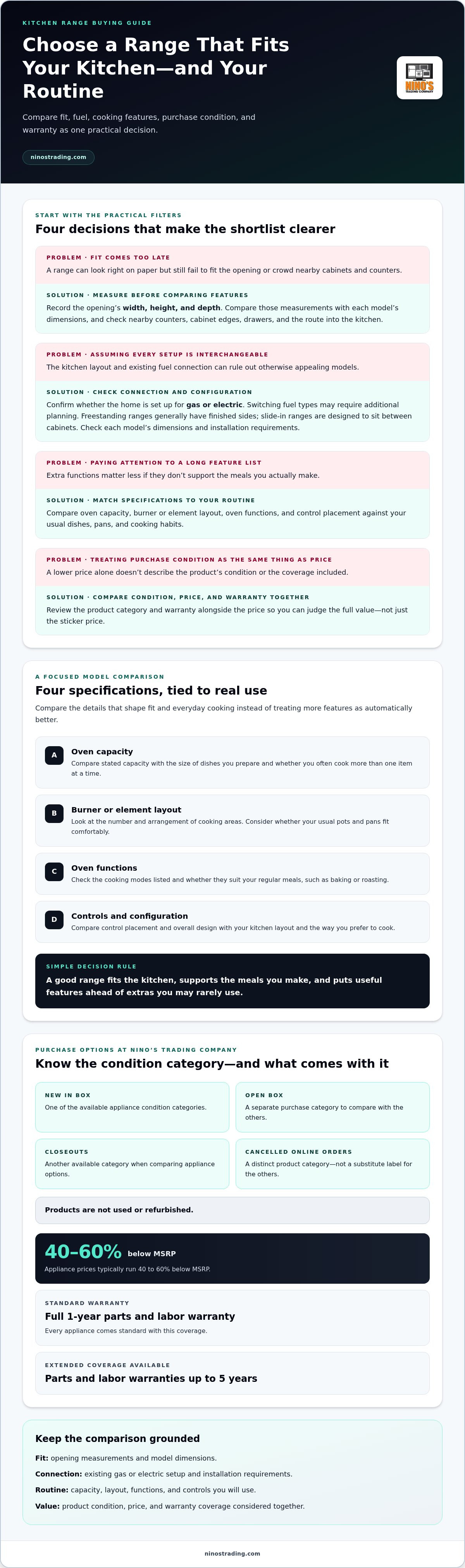
Purchase condition matters, too. Nino’s Trading Company carries new-in-box, open-box, closeout, and cancelled online order appliances, not used or refurbished products. Appliance prices typically run 40 to 60% below MSRP. Every appliance comes with a full one-year parts-and-labor warranty, and extended parts-and-labor warranties are available for up to five years. Comparing condition, features, price, and warranty together gives you a clearer picture of value.
Key Takeaways
- Start with your kitchen’s available space and existing fuel connection to narrow down which kitchen range configurations are practical.
- Prioritize cooktop and oven features that support your everyday cooking instead of paying attention to extras you’re unlikely to use.
- Compare new-in-box, open-box, closeout, and cancelled online order options as separate purchase categories, not interchangeable labels.
- Record the existing opening’s measurements and compare them with each model’s specifications before making your final choice.
- Use the checklist to weigh fit, features, purchase condition, and warranty coverage together when comparing value.
What a Kitchen Range Does, and What to Decide Before Shopping
A kitchen range combines a cooktop and an oven in one appliance. The cooktop handles tasks such as boiling, frying, and simmering, while the oven is used for baking and roasting. For an overview of range components and common types, see this guide to the kitchen stove.
Quick decision summary: First check the available space and the home’s existing fuel connection. Then consider how often you cook, what you prepare, and which features would make those routines easier. These details give you a practical shortlist before you compare individual models.
Which kitchen needs should shape your range choice?
Think about who you cook for and how the appliance fits into a typical week. If you often prepare several dishes at once, compare oven capacity and the cooktop layout with the pans you use most. If you cook less often or mostly make simple meals, a straightforward model may suit you better than one with functions you’re unlikely to use.
Your usual menu can help distinguish useful features from extras. If you bake regularly, compare the oven modes listed for each model with the recipes you make. If you mostly cook on the surface, pay closer attention to element or burner placement and controls. Features you can picture using in your weekly routine are easier to value than options that only sound appealing.
Space is another early filter. In a smaller kitchen, the existing opening and nearby counters may limit your options. A larger kitchen may allow more flexibility, but the appliance still needs to fit the layout and leave room to work comfortably. Measure before comparing features: a range that won’t fit the planned space isn’t a useful candidate.
How does a range fit into a kitchen plan?
Freestanding and slide-in designs differ in how they sit within a kitchen. Freestanding models generally have finished sides, while slide-in models are designed to sit between cabinets for a more integrated look. Treat those descriptions as a starting point, then check the specific model’s dimensions and installation requirements.
Record the width, height, and depth of your existing opening, and compare them with the product dimensions. Also check nearby counters, cabinet edges, and the route into the kitchen. A model may look like a close fit on paper but still interfere with drawers or make the work area feel cramped.
Finally, account for the home’s fuel connection. An existing gas or electric setup can shape which models are practical, while switching fuel types may require additional planning. Keep the connection type alongside your measurements and budget as you narrow the list. Starting with fit, routine, and connection makes it easier to compare useful features without letting extras steer the decision.
Kitchen Range Configurations and Features: Match the Appliance to Your Routine
Once you know the space and fuel connection you’re working with, compare how each configuration fits the kitchen and supports your cooking. Labels help organize options, but they don’t tell the whole story. Check each model’s specifications for dimensions, cooktop layout, oven capacity, and listed functions before deciding whether it suits your home.
Freestanding or slide-in: what changes for the kitchen?
Freestanding ranges typically have finished sides, so they can sit at the end of a cabinet run or between cabinets. Slide-in designs are made to fit between cabinets for a more integrated appearance. Controls may be positioned at the front, which can affect both the look and how you interact with the appliance. Neither style suits every kitchen, so let the layout and the specific model’s dimensions guide your choice.
Consider how the range will meet the surrounding counters and cabinets, and whether the control placement works for your household. Review the model’s installation details rather than assuming every range in a category is identical.
Which oven and cooktop features are worth comparing?
Focus on specifications tied to the way you cook. Use the table to compare models on practical details, rather than treating a longer feature list as a sign of better value.
| What to compare | How it can inform your choice |
|---|---|
| Oven capacity | Consider the size of dishes you regularly prepare and whether you often cook more than one item at a time. Compare stated capacity across models. |
| Burner or element layout | Look at the number and arrangement of cooking areas, then consider whether they leave room for the pots and pans you commonly use. |
| Oven functions | Check which cooking modes are listed and whether they match your regular meals, such as baking, roasting, or other routines. |
| Controls and configuration | Compare control placement and overall design with your kitchen layout and the way you prefer to cook. |
A good range fits the kitchen, supports the meals you make, and puts useful features ahead of extras you may rarely use.
Gas and electric models use different fuel connections, so your home’s existing setup is an important comparison point. Induction is an electric cooktop option; check the model’s stated connection requirements and cooktop specifications. For more background on range types and buying considerations, the Whirlpool Range Buying Guide offers another useful reference.
For a local shopping perspective, explore this Fayetteville stoves buying guide. When comparing a kitchen range, keep a short list of features you’ll use and specifications that matter most. You can also browse ranges at Nino’s with those priorities in mind.
Compare Kitchen Range Purchase Options Without Confusing Price and Condition
Price helps narrow a shortlist, but it doesn’t tell you everything about a range. Purchase labels describe how an appliance is offered; they don’t replace the item’s specifications, features, or warranty details. Nino’s carries new-in-box, open-box, closeout, and cancelled online order appliances, not used or refurbished products. Compare the details of each range with what your kitchen requires.
What do the different purchase categories mean?
Use each category label as a starting point, not a complete description of a specific appliance. A label alone doesn’t tell you the model’s features or dimensions, and two ranges in different categories shouldn’t be assumed to have identical details. Review the information for the particular appliance you’re considering.
| What to compare | How it helps |
|---|---|
| Purchase label | Shows the category under which the appliance is offered, but doesn’t replace item-specific details. |
| Product information | Helps you assess the particular range’s features and specifications against your needs. |
| Warranty terms | Gives you another point of comparison when weighing an appliance’s overall value. |
| Listed price | Lets you compare the cost of options with similar features and suitability for your kitchen. |
How should shoppers weigh price against purchase details?
First rule out ranges that don’t match your space or connection requirements, then compare the remaining models. If two appliances both suit your kitchen, consider whether their features support your cooking habits and how their warranty terms factor into the decision. Nino’s appliance prices typically run 40 to 60% below MSRP, and every appliance comes with a full one-year parts-and-labor warranty. Extended parts-and-labor warranties are available for up to five years. Compare the stated terms for the appliance and coverage you’re considering, rather than treating a lower price as automatic proof of better value.
A simple note for each candidate can keep the decision clear:
- Product fit: Does the range match your kitchen and connection requirements?
- Useful features: Does it include functions you expect to use?
- Purchase details: What does the item’s label and individual information tell you?
- Overall value: How do the price and stated warranty compare with the features you need?
This approach keeps price, label, product details, and warranty separate while still considering them together. For another practical way to compare appliance categories and fit, compare appliance sales options.
Kitchen Range Shopping Checklist: Check Fit, Connections, and Priorities
A short, ordered check can prevent a promising model from making your shortlist for the wrong reasons. Keep your measurements and notes together, then compare them with each range’s product specifications and manufacturer installation requirements. Requirements vary by model, so use the details for the specific appliance rather than assuming one set of dimensions or connections applies to every range.
- Measure the existing opening. Record its width, height, and depth, and note any uneven edges or nearby surfaces that could affect the fit. Use the same points for each measurement so you can compare models consistently.
- Check the route into the kitchen. Consider doorways, hallways, and turns between the entrance and the appliance location. The range needs to fit the installation space and the route into the room.
- Compare model dimensions. Match your measurements with the product specifications for each candidate. Don’t assume ranges share identical dimensions just because they have the same general configuration or appearance.
- Review the surrounding layout. Look at adjacent cabinets and counters, along with nearby doors and drawers. Consider whether the selected model’s shape and control placement work with the available space.
- Identify the home’s current fuel connection. Note whether the existing setup is gas or electric, then compare it with the fuel type and connection requirements listed for each appliance. This can help narrow the shortlist before you focus on extra features.
- Read the manufacturer’s installation requirements. Check the specific model’s instructions for placement and connection requirements. Details vary between models, so avoid relying on assumptions based on another range or a broad category label.
- Rank features by your cooking routine. Write down the functions and cooktop layout details that would help with meals you regularly make. Focus on features you can see yourself using.
- Compare purchase details and warranty terms. For each final option, note its purchase category, product details, listed features, and warranty terms. Consider the full package instead of letting a single feature or price decide for you.
Working through the list in order helps rule out models that don’t suit the space or connection before you weigh smaller differences. Keep a simple comparison note for the finalists, including dimensions, fuel requirements, useful features, purchase category, and warranty information. That makes it easier to see which option fits your priorities without relying on memory or a headline claim.
Once your measurements and priorities are ready, compare ranges at Nino’s against your checklist and narrow the options to models that suit your kitchen.
Shop Kitchen Ranges with Nino's: Compare Value and Warranty in Arkansas and Oklahoma
With your measurements and priorities in hand, compare ranges by fit, useful cooking functions, purchase details, and warranty, not by one appealing feature alone. Nino’s sells ranges and stoves to shoppers across Arkansas and Oklahoma, including Bentonville, Fayetteville, Springdale, Rogers, Little Rock, and Fort Smith, as well as Tulsa, Oklahoma City, Broken Arrow, Yukon, Mustang, and Edmond.
How does warranty coverage support a range purchase?
Include warranty terms when comparing options. Every appliance at Nino’s comes with a full one-year parts-and-labor warranty, and extended parts-and-labor warranties are available for up to five years. Review the stated terms alongside the range’s features and purchase details, then weigh the coverage you prefer as part of your overall decision. This gives you a fuller comparison than looking at price alone.
A practical final review can be brief. Keep your measurements beside the model specifications, then check that the fuel connection and features fit your needs. After that, consider the purchase details, price, and warranty together. This keeps the choice grounded in your home and cooking habits, rather than in a broad label or a single selling point.
What is the next step for regional shoppers?
Shoppers in Bentonville, Fayetteville, Springdale, Rogers, Little Rock, and Fort Smith, as well as Tulsa, Oklahoma City, Broken Arrow, Yukon, Mustang, and Edmond, can use the same comparison approach: start with the kitchen’s requirements, then evaluate each range on its specifications and terms. Let your checklist guide the decision, whether you’re shopping in Arkansas or Oklahoma.
Take your notes with you as you review the options. Explore Nino's appliance selection to compare ranges and stoves for your kitchen.
Take the Next Step Toward a Better-Fitting Range
Your purchase decision can be simpler if you treat it as a match, not a hunt for the most features. Consider how you want your kitchen to work day to day, then use those priorities to judge which kitchen range is a practical fit. The right choice should make sense for your space and routines, not just look appealing on a product page.
Before browsing, keep your notes nearby so you can compare options with a clear purpose. If a model catches your eye, consider whether it supports the way you cook and works with your home’s setup. Focused comparison can help you choose with confidence instead of rushing toward a range that doesn’t suit your needs.
Ready to compare? Explore Nino's kitchen range and appliance options and find a range that fits your kitchen, priorities, and budget.
Frequently Asked Questions
This guide is for homeowners comparing ranges in Bentonville, Fayetteville, Springdale, Rogers, Little Rock, and Fort Smith, as well as Tulsa, Oklahoma City, Broken Arrow, Yukon, Mustang, and Edmond.
Is a kitchen range the same thing as a stove?
In everyday use, “range” and “stove” often refer to the same appliance: one unit with a cooktop and an oven. Some people use “stove” to mean only the cooktop, so the terms can vary by conversation. When shopping, check the product description and specifications to confirm that the appliance includes the cooking components you expect, rather than relying on the name alone.
What does dual fuel mean on a kitchen range?
Dual fuel generally means a range pairs a gas cooktop with an electric oven. That combination uses two fuel types, so it needs compatible connections for both. Before comparing dual-fuel models, review the model’s specifications and installation requirements alongside your home’s existing setup. The term describes the cooking-fuel arrangement, not a guarantee that the appliance will connect to every kitchen without changes.
Can I replace a gas range with an electric range?
Yes, but the home’s electrical connection must meet the replacement model’s requirements. A gas connection alone won’t power an electric range, so check the specifications and installation instructions before buying. For example, a home may need electrical work to support the model. Treat the fuel change as part of the appliance decision, not a detail to address after choosing a range.
Can I replace an electric range with a gas range?
It may be possible, but the kitchen needs a compatible gas connection and the setup required by the selected model. An existing electric connection doesn’t establish that a gas range can be connected as-is. Review the appliance’s installation information and consider the home’s current utilities before settling on a model. If the required setup differs, account for that work as part of the replacement plan.
Can I use my existing cookware on an induction range?
Only cookware with a magnetic base will work on an induction cooktop. A simple check is to place a magnet against the bottom of each pan. If it sticks firmly, the cookware is generally compatible; if it doesn’t, it likely won’t heat on induction. Also consider the pan’s base shape and size, since cookware that sits steadily over the cooking area is easier to use.
Does a kitchen range need ventilation?
Ventilation helps move cooking heat, steam, and odors out of the kitchen, so it’s a practical part of planning a range area. The right setup depends on the kitchen layout and the appliance. Review the range’s installation guidance and consider how cooking smells and moisture move through the room. Don’t assume every model or kitchen has identical ventilation requirements.
How do you clean a kitchen range without damaging it?
Start by turning the range off and letting it cool, then follow the manufacturer’s cleaning instructions for its specific cooktop and oven surfaces. For routine marks, a soft cloth with mild soapy water is a gentle starting point. Avoid abrasive pads or harsh cleaners unless the instructions allow them, and keep liquid away from controls and electrical areas. Clean spills promptly once the surface is safe to touch.


