
Could a refrigerator fit its kitchen opening and still fail to make it through the front door? It can happen when you measure only the space where the appliance will sit. If you’re wondering how to measure for a new refrigerator, check the opening, the room around it, and the full route into your home before you shop.
Width, height, and depth are essential, but door swing, drawer access, and ventilation clearances matter too. Requirements vary by model, so compare your measurements with the specifications for each refrigerator you’re considering. This guide explains how to measure the opening, account for doors and drawers, and check doorways, hallways, and tight turns along the delivery route. With those details recorded, you can narrow your options and avoid fit surprises.
Key Takeaways
- Measure the usable refrigerator opening and record its width, height, and depth before comparing models.
- Check door and drawer movement so nearby walls, counters, islands, and handles won’t get in the way.
- Compare each model’s listed dimensions and required clearances with your measurements.
- Trace the route from the entrance to the kitchen, noting narrow doorways, hallways, stairs, and tight turns.
- Keep your measurements together and confirm close fits against the exact refrigerator’s specifications and installation guide.
Start measuring for a new refrigerator by mapping the opening
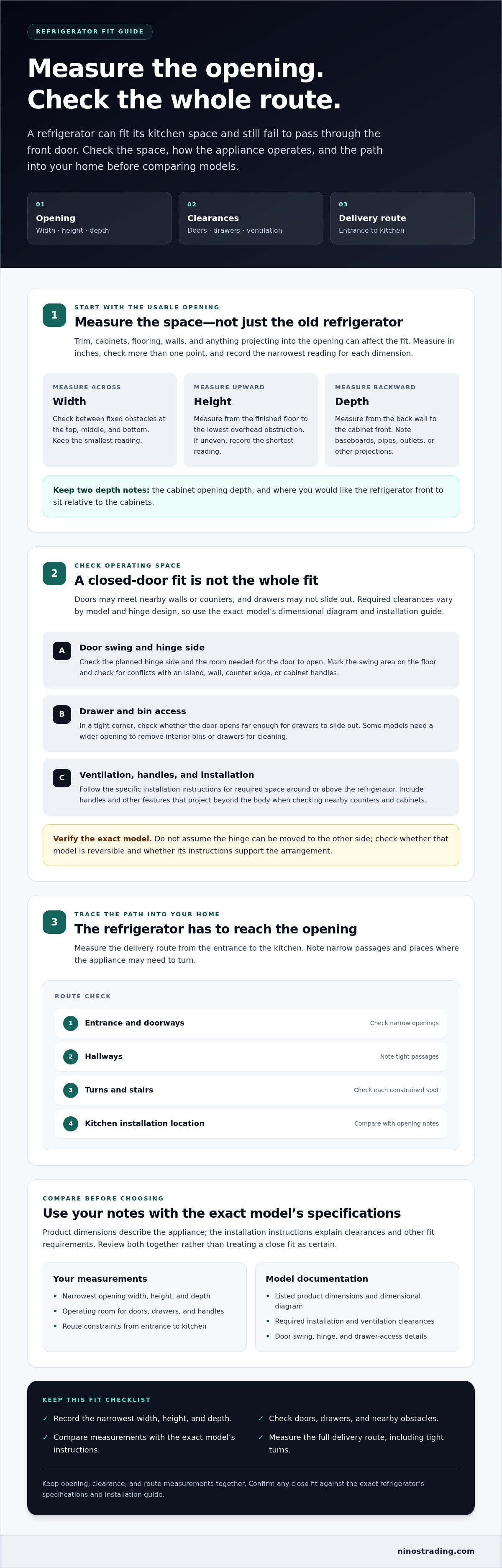
Measure the available space, not just the old refrigerator. The existing appliance may be smaller than the opening, or its position may not show where the space narrows. The refrigerator opening is the usable width, height, and depth at the installation location. Trim, cabinets, flooring, and nearby walls can all affect those measurements.
Use a tape measure to record each dimension in inches. Check the opening at more than one point and use the narrowest reading for width, height, and depth. Label where each measurement was taken so you can compare models accurately. A general overview of refrigerator types and sizes can help you get familiar with the category, but check the exact model’s specifications to confirm fit.
How to measure refrigerator opening width and height
For width, measure between the closest fixed obstacles at the top, middle, and bottom of the opening. A wall, cabinet edge, or piece of trim may make one point tighter than the others. Record each reading and use the smallest as the available width.
For height, measure from the finished floor to the lowest cabinet or other overhead obstruction. If the floor or cabinet line isn’t level, check more than one spot and record the shortest measurement. Measuring from the finished floor accounts for the surface the refrigerator will actually stand on.
How to measure the available refrigerator depth
Measure from the back wall to the front edge of the surrounding cabinets. Note anything that projects into the space, such as a baseboard, pipe, or outlet, and check how it affects the usable depth. If an obstruction sits behind the refrigerator, the wall-to-cabinet measurement alone may overstate the space available.
Record cabinet depth separately from your preferred finished-front alignment. The first describes the opening; the second captures how far you’d like the refrigerator front to sit relative to the cabinets. Keeping both notes makes it easier to compare product dimensions without assuming the appliance will line up exactly with the cabinetry.
Measure refrigerator clearances so doors and drawers work
A refrigerator can fit its opening and still be awkward to use if the doors hit a wall or the drawers can’t slide out. Check the space the appliance needs while in use, not just the space it occupies when closed. Clearances vary by model and hinge design, so confirm requirements in the specific model’s installation instructions.
Check door swing, hinges, and drawer access
Check the planned hinge side and measure the space beside the refrigerator for the open door. Use the model’s documentation to see how far the door extends as it swings. You can mark that area on the floor with painter’s tape, then check for conflicts with an island, wall, counter edge, or cabinet handles. In a tight corner, consider whether the door can open far enough for drawers to slide out.
Some models may need the doors to open beyond their usual resting position to remove interior bins or drawers. A door that opens enough for everyday use may not provide enough space to take a drawer out for cleaning. Don’t assume the hinge can be moved to the other side. Check whether the door is reversible on that exact model and whether its instructions support the arrangement you need.
Allow for ventilation and installation requirements
Manufacturers may require space around or above a refrigerator for ventilation and installation. Requirements vary, so use the exact installation guide rather than a general clearance rule. Compare the instructions with your measured opening, including any obstruction that could limit how far the appliance can sit from the wall.
Include handles and other features that project beyond the refrigerator body when checking the fit near counters or cabinets. Listed product depth may not include every protruding feature, and the door’s movement takes additional room. Review the model’s dimensional diagram and installation details together. Check that the planned position allows the required space and lets doors and drawers work as intended.
Keep operating clearances in a separate note alongside your opening measurements. That makes it easier to compare models without treating a close fit as a sure fit. Use those notes when comparing available refrigerators, and verify the exact model’s specifications before deciding.
Compare refrigerator dimensions with the space you measured
Put your opening, clearance, and delivery-route measurements beside the specifications for each refrigerator you’re considering. Listed width, height, and depth describe the appliance, not necessarily the full space it needs to fit, open, and operate. Use the specification sheet and installation instructions together, since they cover different parts of the fit.
This table can help you keep the details straight. Add your opening and route measurements, then check the exact model’s documentation for product dimensions and required clearances.
| What to compare | Your measurement | Model or installation details |
|---|---|---|
| Opening width, height, and depth | Smallest usable measurement for each | Product width, height, and depth |
| Operating space | Room beside and above the appliance | Door swing and required installation clearances |
| Delivery route | Narrowest doorway, hall, stair, or turn | Dimensions needed to assess passage |
What refrigerator dimensions on a specification sheet mean
Start with the product’s listed width, height, and depth, then check how those measurements were taken. Confirm whether depth includes handles or other parts that project from the cabinet. A dimensional diagram or manufacturer documentation can clarify what each measurement covers. Don’t assume different listings use the same conventions; check the details for each model.
How refrigerator style can affect fit
Door and drawer layouts affect how you use the space around a refrigerator. French-door models have two upper doors, side-by-side models have doors that open from the center, and top-freezer models place the freezer above the fresh-food compartment. Even with similar exterior dimensions, their doors and drawers may move differently. Choose a layout that works with your clearances and daily routine, not just a style label.
“Counter-depth” and “standard-depth” describe broad design choices, but neither guarantees a flush fit with your cabinets. Handles, door shape, and the manufacturer’s measurement method can affect how far the appliance projects. Compare full specifications with your notes and confirm installation requirements before treating a close match as a fit.
Measure the delivery route before ordering a refrigerator
A refrigerator that fits the kitchen opening still needs a clear path to get there. Trace the route from the entrance to the installation spot, checking every doorway, hallway, stair, and turn the appliance must pass through. Measure each tight section at its narrowest usable point and compare those dimensions with the exact refrigerator’s specifications. Pay particular attention to places where the appliance needs to turn or pass through a confined space.
Measure doors, hallways, stairs, and tight turns
For each doorway, record the clear opening width and height, accounting for the door and frame rather than measuring the rough opening behind them. Check hallway pinch points, corners, and turning areas where the refrigerator may need to change direction. If the route includes stairs, measure the landing and note low ceilings or other overhead restrictions. Label each measurement by location so you can quickly identify the tightest part of the route.
Note potential temporary obstacles, such as a door that might be removed, but only count on removal if it’s practical and confirmed. A measured route alone doesn’t guarantee access. Ask the retailer what delivery dimensions and route details they need, and whether specific access requirements apply. Share tight turns or unusual obstacles before ordering rather than relying on a doorway measurement alone.
Prepare a fit checklist before shopping
Keep your kitchen opening, operating clearance, and delivery-route measurements in one phone note or document. Include the narrowest usable width and height at each point, plus depth or turning-area details that could affect passage. Photos of the installation space, doorway frames, stairs, and tight corners can help explain the route when you discuss a refrigerator with a retailer. Label each photo so it’s clear where the measurement applies.
Compare your route notes with the exact model’s dimensions, then confirm delivery requirements with the retailer. Once your checklist is ready, the discount refrigerator shopping guide for Oklahoma City offers more shopping considerations. Use your measurements when you compare available refrigerators, and verify current model details before deciding.
Use your measurements to choose a refrigerator with confidence
You don’t need a complicated plan to compare refrigerators, but you do need a complete one. Keep your measurements and the exact model’s specifications together so you can check the opening, everyday use, and delivery access before choosing. Learning how to measure for a new refrigerator means comparing all three, not just matching the appliance to the kitchen opening.
A final refrigerator fit checklist
Before comparing options, make sure your notes include:
- Opening: The narrowest usable width, height, and depth, measured from fixed surfaces.
- Clearances: Room for doors to swing, drawers to open or come out, and the manufacturer’s stated installation requirements.
- Delivery route: Usable measurements of doorways, hallways, stairs, and turns along the planned path.
- Model details: Exact product dimensions and notes on handles, hinges, or measurement conventions.
Recheck any close fit against the specific model’s specification sheet and installation guide. A small difference in a measurement or a door’s movement can matter, so don’t rely on a general size label alone. If you’re unsure about a dimension, confirm it in the manufacturer’s documentation before deciding.
What to do if the refrigerator space is an unusual size
If your opening is uneven or varies from one side to the other, measure again from fixed surfaces and record what you find. Note sloped flooring, uneven walls, trim, and other features that affect usable space. Then compare individual refrigerators using their published dimensions and installation requirements. Category labels can help you sort options, but they can’t confirm that a specific model will fit.
Shoppers in Little Rock, Fort Smith, Tulsa, Oklahoma City, Fayetteville, Springdale, Rogers, and Bentonville can keep their measurements handy when asking about available refrigerators. Sharing the opening, clearance, and delivery-route details gives you a clear basis for discussing options without assuming a particular model is available or suitable.
When your checklist is ready, browse refrigerators from Nino's Trading Company and use your notes to compare available options. Check the exact model details carefully, especially when the fit is close, and choose a refrigerator that works in both the kitchen and the route into your home.
Shop with your measurements in hand
A refrigerator needs to fit more than the kitchen opening. Before choosing one, check the narrowest width, height, and depth of the space, confirm that doors and drawers can move, and compare the model’s specifications with the full delivery route. These are the practical basics of how to measure for a new refrigerator, and they can help you avoid surprises after you’ve made your choice.
Keep your measurements together as you compare options, and recheck a close fit against the exact model’s specifications and installation guide. Nino’s Trading Company carries refrigerators, including closeout, open box, and scratch and dent options. Browse the current selection with your notes nearby, then compare each refrigerator’s details with your kitchen and delivery route.
Browse refrigerators from Nino’s Trading and compare the available options with your measurements. Taking time to check the fit can make choosing a refrigerator more straightforward.
Frequently Asked Questions
How do I measure the space for a new refrigerator?
Measure the usable opening’s width, height, and depth, then use the narrowest reading for each dimension. Check width at the top, middle, and bottom, and measure height from the finished floor to the lowest overhead obstruction. Measure depth from the back wall to the cabinet front, noting anything that sticks out. Also check door movement and the route into the kitchen.
Should I measure my old refrigerator or the opening?
Measure the opening, not just the old refrigerator. The existing appliance may be smaller than the available space, or it may not show where cabinets, trim, walls, or flooring narrow the usable area. Measuring the opening gives you a better basis for comparing models. You can note the old refrigerator’s size for reference, but don’t assume a replacement with the same dimensions will meet clearance or installation requirements.
How much space should I leave around a refrigerator?
There isn’t one clearance amount that applies to every refrigerator. Requirements vary by model and design, so check the exact appliance’s installation guide for the space needed around or above it. Follow those instructions when comparing the model with your measured opening. Also check whether doors can swing and drawers can open without hitting a wall, island, counter, or cabinet handle.
Do refrigerator dimensions include the handles?
It depends on how the manufacturer lists the measurements. A specification sheet may show cabinet depth separately from handles or other parts that project outward. Check the model’s dimensional diagram and documentation to confirm what its width, height, and depth include. This matters when comparing the refrigerator with counters or nearby cabinets and estimating how far its front may extend into the room.
How do I measure a doorway for refrigerator delivery?
Measure the clear width and height of each doorway along the route, including the entrance and any doorway between the kitchen and hall. Check hallways, stairs, landings, and tight turns at their narrowest usable points. Record each measurement and where you took it, then compare the route with the specific refrigerator’s dimensions. Ask the retailer about delivery requirements too, since measurements alone don’t confirm access.
What if the refrigerator is slightly bigger than my opening?
Recheck the opening from fixed surfaces and confirm the model’s exact dimensions and required installation clearances. A refrigerator that exceeds the usable opening may not fit as planned. Don’t assume that removing a door or changing the space will solve the problem. Check with the retailer about the model and delivery requirements before ordering. If it still appears too large, compare other refrigerators with your measurements.
Is counter-depth the same as a refrigerator that fits flush?
No. “Counter-depth” describes a general design, but it doesn’t promise that a refrigerator will sit flush with your cabinets. The appliance’s body, handles, door shape, and the manufacturer’s measurement conventions can affect how far it projects. Compare the exact model’s dimensions with your cabinet depth and preferred alignment, and check its installation guide. Shoppers in Little Rock, Fort Smith, Tulsa, Oklahoma City, Fayetteville, Springdale, Rogers, and Bentonville can use those measurements when comparing available refrigerators from Nino’s Trading Company.


