

A dent-removal trick can make a stainless-steel finish look worse if it’s used on the wrong kind of damage. Learning how to clean scratch and dent stainless steel starts with identifying what you’re seeing: brushed grain can resemble fine scratches, while a deeper mark or dent won’t disappear with routine cleaning.
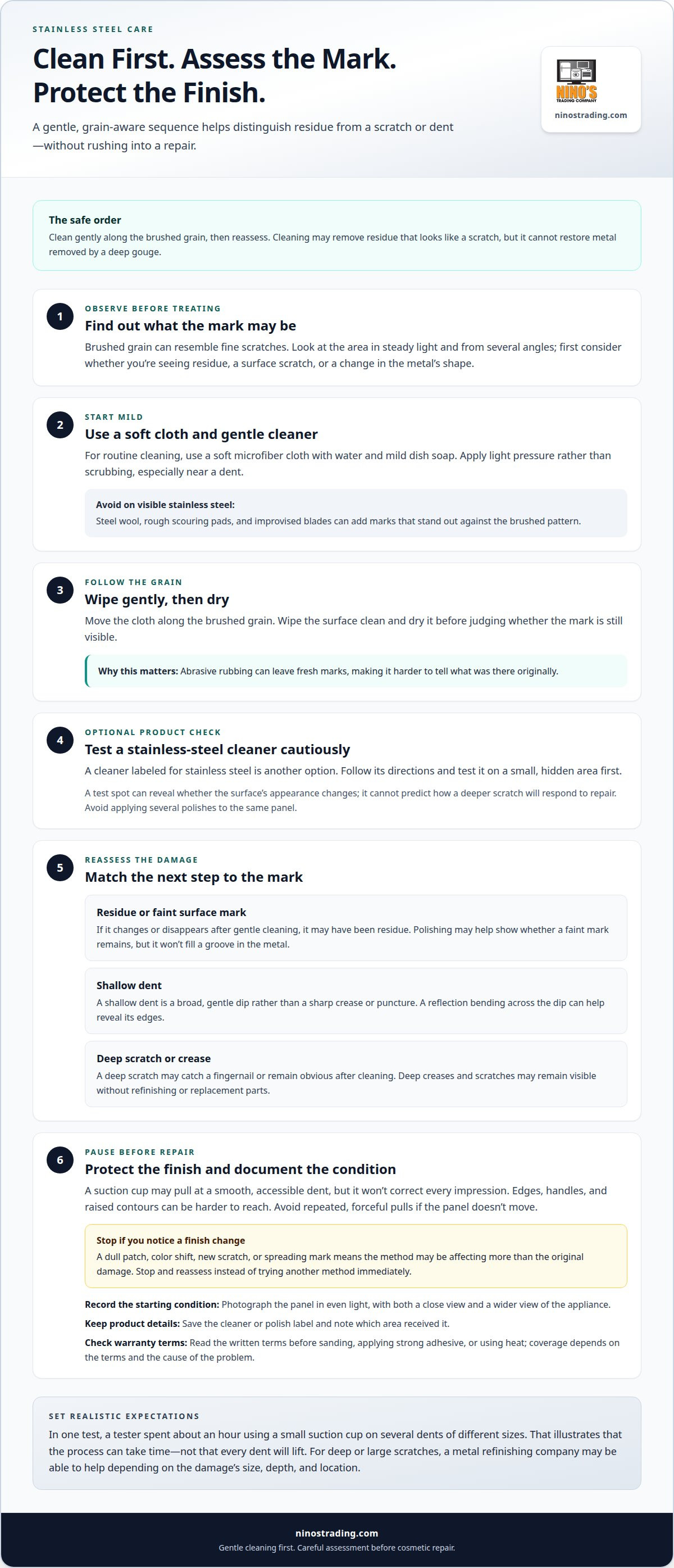
It’s understandable to want to restore an appliance’s smooth appearance without causing more damage. Start by cleaning gently along the brushed grain, then assess whether the mark is residue, a surface scratch, or a dent before trying a repair method.
This guide explains how to clean stainless steel without scratching it, which dents and deeper scratches may be repairable, and what to consider before trying suction cups or other DIY techniques. You’ll also learn how polishing products and abrasive methods can change the finish, and why it’s sensible to review your appliance’s warranty terms before attempting a cosmetic repair.
Key Takeaways
- Learn how to tell ordinary brushed grain from a scratch that may need more than cleaning.
- See why shallow dents and deep damage can call for different repair approaches.
- Understand how DIY dent-removal methods may affect the appliance’s finish, and why warranty terms matter before you try them.
- Use gentle cleaning steps that follow the grain and help reduce the chance of adding new marks.
- Explore Nino's Trading Company's cancelled online orders, open-box, closeout, and new-in-box appliances when considering a replacement.
Can You Repair Dents & Deep Scratches?
Dents and scratches often result from an impact, moving an appliance, or rubbing the surface with an abrasive pad. Repair depends on the damage’s depth, size, and location, not just how visible it is.
Shallow dents may become less noticeable after careful cosmetic work, while deep creases or scratches can remain visible without refinishing or replacement parts. Before attempting a fix, distinguish surface damage from a mark that changes the metal’s shape.
Setting Expectations for Shallow Dents
A shallow dent has a broad, gentle dip rather than a sharp crease or puncture. Look at it from several angles under steady light. A reflection that bends across the dip can help reveal its shape and edges.
A suction cup may pull at a smooth, accessible dent, but it won’t correct every impression. In one test, a tester spent about an hour using a small suction cup on several dents of different sizes. This example shows that the process can take time, not that every dent will lift.
Location also matters. A dent near an edge, handle, or raised contour may be harder to reach than one on a broad, flat panel. Avoid repeated, forceful pulls if the panel doesn’t move, since extra pressure can distort the surrounding area.
Handling Deep or Large Scratches
Deep scratches go beyond faint surface marks and may catch a fingernail or remain obvious after cleaning. A metal refinishing company may be able to repair deep or large stainless-steel scratches, depending on their size, depth, and location.
Professional assessment can help when a scratch crosses the brushed pattern, covers a large area, or leaves a pronounced groove. The repair approach depends on how much material is affected and whether the surrounding finish can be blended without creating a larger visible patch.
Some Factory Certified Service companies can repair minor stainless-steel scratches, but not all offer cosmetic repair. If an impact has affected mechanical performance or internal components need servicing, technicians such as Access Refrigeration & Appliance Repairs can provide on-site evaluation, while a Factory Certified Parts Distributor can be contacted to order replacement parts if a damaged component needs replacing.
Scratches aren’t considered normal on a new stainless-steel unit. If an appliance is damaged when new, document the mark and its location before trying abrasives or polish. Cleaning may remove residue that looks like a scratch, but it won’t restore metal removed by a deep gouge.
For a dent or scratch, consider the panel’s shape, damage depth, and position before choosing a method. A shallow depression on a flat door differs from a sharp crease or a deep scratch through the grain. Stop DIY attempts if the finish changes or the mark spreads.
Risks of damaging an appliance's finish or warranty
A repair attempt can change more than the dent: an abrasive pad may leave fresh marks, and polishing can alter the surrounding sheen. Before using a product or tool, identify the damaged area and consider whether the method touches only the mark or a wider section of the panel.
Heat, glue, suction, and scraping each affect the surface differently. For example, pulling a glued tab away can disturb the finish around a dent, while scraping residue with a hard edge can add visible lines. Avoid combining methods in quick succession. If an attempt leaves residue or a new mark, stop and assess the panel before trying another.
Warranty documents matter because coverage depends on the written terms and the cause of the problem. A cosmetic mark, a failed appliance part, and damage during a DIY attempt are different situations to describe. Before sanding, applying strong adhesive, or using heat, read the warranty terms for exclusions and instructions about modifications or repairs.
- Record the starting condition. Photograph the panel in even light, including a close view and a wider view that shows the appliance.
- Keep product details. Save the cleaner or polish label and note which area received it.
- Stop at a finish change. A dull patch, color shift, or new scratch means the method is affecting more than the original mark.
Use a mild, nonabrasive cleaning method before considering cosmetic treatment. Test an unfamiliar cleaner on a small, inconspicuous area, follow its label, and wipe it away before assessing the result. A test spot can show whether the surface’s appearance changes, but it can’t predict how a deeper scratch will respond to repair.
Avoid steel wool, rough scouring pads, and improvised blades on visible stainless steel. They can create scratches that stand out against the original brushed pattern. Also avoid applying several polishes to the same panel; residue can make it harder to tell whether the original mark has changed.
If the appliance is covered by a warranty, keep its model information and written terms nearby while deciding what to do. Describe the issue accurately as a dent, surface mark, or damaged finish. This distinction helps separate a cosmetic repair from an appliance-performance concern and prevents an uncertain DIY step from obscuring what happened.
Testing DIY dent-removal methods on a stainless steel dishwasher
DIY dent methods rely on suction or pulling force, and a dishwasher panel’s shape affects access. Testing tools can illustrate their limits, but the test setup alone doesn’t establish that a method will repair every dent.
Safe Cleaners and Abrasives
For routine cleaning, use a soft microfiber cloth with water and mild dish soap, then wipe and dry the stainless steel. A cleaner labeled for stainless steel is another option; follow its directions and test it on a small, hidden area first. Use light pressure rather than scrubbing, especially near a dent where the surface may already be distorted.
Polishing can help show whether a faint mark is residue or a scratch, but it won’t fill a groove in the metal. Avoid abrasive cleaners for this check. A clean, dry cloth also makes it easier to see whether cleaning changed the appearance, rather than mistaking leftover moisture for a finish difference.
Products to Avoid on Stainless Steel
Keep steel wool, rough scouring pads, and abrasive powders away from visible stainless-steel panels. They can leave new marks or change the sheen around the original dent. Don’t use a hard blade to scrape a mark, either; a slip can create a sharper scratch than the one you were trying to remove.
Avoid improvised chemical mixes and products without directions for stainless steel. If a cleaner’s label doesn’t describe use on the surface, choose a gentler method instead. Mixing products also makes it harder to identify which one caused a change, such as a dull patch or streak.
What DIY Dent Tests Can Show
In a dishwasher dent test, larger suction cups were roughly 6 inches across, while smaller cups measured 1.5 inches. The different sizes illustrate why cup fit matters: a cup needs a smooth, broad contact area to form suction. A dent near a handle, edge, or curved section may not provide that surface.
The hot-glue test used three pulling tools: a hand jack, a twisting vice, and a tension rod. Each applies force differently, but the setup doesn’t prove that a specific tool will remove a dent cleanly. Glue can leave residue, and pulling can affect the surrounding panel, so avoid forceful attempts if the metal begins to flex unevenly.
Professional stainless-steel dent and scratch repair costs depend on the work involved, including the damage’s size, depth, location, and accessibility. There isn’t one useful price for every dishwasher; these factors shape the repair approach and estimate.
Before using suction or glue, clean and dry the test area, then inspect the dent under steady light. Stop if the panel shifts, the finish changes, or the tool won’t hold securely. A shallow, accessible dent differs from a sharp crease, and repeated pulling may make the surrounding area harder to restore.
the panel and check that the area is accessible. A maintenance supervisor who testified on the page says they oversee more than 300 units, a reminder to assess the appliance before choosing a repair approach.
Brushed grain direction
The brushed grain appears as fine lines running in a consistent direction across stainless steel. Those lines can look like hairline scratches, but that appearance is normal.
Following the Brushed Grain
Look closely at a clean, dry panel and identify whether its lines run horizontally or vertically. Follow that direction when wiping or polishing; moving across it can make fresh marks more noticeable. For example, if a refrigerator door’s grain runs from left to right, wipe in that direction rather than scrubbing in circles.
Grain direction may differ between appliance parts, so don’t assume the handle and door share the same pattern. Check each surface separately. On a dishwasher panel, the lines may be easier to see near an edge where light falls across the finish.
Cleaning Without Scratching
Start with a soft cloth and mild soap solution, then wipe in the direction of the visible grain. Use a clean section of the cloth as it collects grime, so trapped particles don’t drag across the panel. Rinse away soap residue with a damp cloth, then dry the surface with another soft cloth.
Use light pressure around handles, seams, and corners, where cloth edges can catch. Avoid scrubbing back and forth across the grain. A gentle pass is enough for fingerprints or surface residue; don’t tackle stubborn marks with a rough pad or hard object.
Before treating a faint line as a scratch, clean and dry the area, then inspect it under steady light. Polishing stainless steel first can help determine whether an apparent scratch is actually a smudge. If the mark disappears after cleaning, no scratch-removal treatment is needed.
Removing Light Scratches Along the Grain
For a light mark that remains after cleaning, first confirm whether it follows the grain or crosses it. Choose a product labeled for stainless steel and follow its directions. Test it in an inconspicuous area, then apply a small amount with a soft cloth, using short strokes along the grain.
Pause after a few strokes and inspect the finish from the same angle. Don’t press harder just because the line remains visible; excess pressure can create a dull patch or uneven sheen. Avoid sanding or using an abrasive pad unless the appliance’s care instructions specifically allow it.
A scratch that cuts across the brushed lines may be harder to blend than a faint mark running with them. Stop if the test area changes appearance or the scratch catches a fingernail. Cleaning can remove residue, but it can’t replace metal removed by a deeper groove.
How to clean stainless steel without scratching it
Small scratches can develop during regular use, but careful cleaning helps prevent additional marks. Start by removing loose crumbs or grit, since particles trapped under a cloth can drag across an appliance’s surface. A gentle routine is the safest starting point when deciding how to clean scratch and dent stainless steel without worsening its appearance.
Use this sequence for a refrigerator door, dishwasher front, or another stainless-steel panel:
- Check the care instructions. Follow the appliance maker’s guidance for cleaners and surface treatments.
- Remove loose debris. Lift crumbs and dust with a soft, dry cloth before adding moisture.
- Clean gently. Dampen a microfiber cloth with water and mild dish soap, then wipe along the visible grain.
- Remove soap residue. Use a separate clean, damp cloth, then dry the surface with a soft towel.
- Inspect the result. Look at the panel under steady light after it’s dry, not while water streaks remain.
Keep the cloth clean as you work. If it picks up gritty residue, switch to a fresh section rather than rubbing that material over another part of the door. Use light pressure around handles, seams, and trim, where dirt can collect and cloth edges may snag.
For fingerprints or greasy spots, repeat the mild-soap cleaning step instead of reaching for a rough pad. If residue remains, use a stainless-steel cleaner only when its label permits use on that surface, and follow its directions. Don’t apply multiple products at once; leftover cleaner can make streaks harder to identify and remove.
A faint line may be residue rather than a scratch. Polishing stainless steel first can help distinguish an apparent scratch from a smudge. Clean and dry the area, then inspect it before trying any scratch treatment. If the line disappears, further rubbing or polishing could create marks that weren’t there before.
Water spots need a different response from stuck-on food. Drying the panel after rinsing helps prevent visible droplets from remaining on the finish. For a persistent spot, dampen a soft cloth and wipe the area gently, then dry it. Avoid scraping dried residue with a blade or hard-edged tool.
Never use steel wool or rough scouring pads on a visible stainless-steel surface. They can leave scratches and change the finish. Avoid abrasive powders and hard brushes, too. If a cleaning method leaves a dull patch or fresh line, stop and don’t repeat it across the panel.
Regular gentle wiping is easier on the finish than aggressive scrubbing after buildup forms. For routine care, use a soft cloth, mild soap, and clean water, then dry the panel. Learning how to clean scratch and dent stainless steel safely means choosing a method suited to the mark and stopping if the surface changes.
Nino's Trading Company: Appliance Deals
Nino's Trading Company offers cancelled online orders, open box, closeouts, and new in box appliances for shoppers considering a replacement. These options can be a practical next step when you need another appliance, or when you’d rather compare available products than risk changing an appliance’s finish with further DIY work.
Options include Refrigerators and Washers and Dryers, alongside other appliances. The inventory consists of cancelled online orders, open box, closeouts, and new in box products, not used or refurbished appliances. Appliances include a full 1 year parts and labor warranty, with extended parts and labor warranties available up to 5 years.
If you’re weighing repair against replacement, contact Nino's Trading Company to discuss your appliance needs.
Choose the next step that fits your appliance
Before trying another cosmetic fix, decide what matters most: improving the panel’s appearance or replacing the appliance. A faint mark may be easier to live with than a finish altered by repeated polishing, while a prominent dent can make replacement worth considering. Your appliance’s condition, care instructions, and warranty terms can guide that decision.
If you’re considering a replacement, Nino's Trading Company offers refrigerators, washers and dryers, and TVs. Its cancelled online orders, open-box, closeout, and new-in-box appliances are another option to consider alongside continued care of the appliance you already own. Knowing how to clean a stainless-steel appliance can help you care for its surface, but it doesn’t mean every dent or deep mark can be removed at home.
Take a moment to compare your options, then Contact Nino's Trading Company to discuss what you’re looking for. A careful choice can help you move forward with confidence.


