

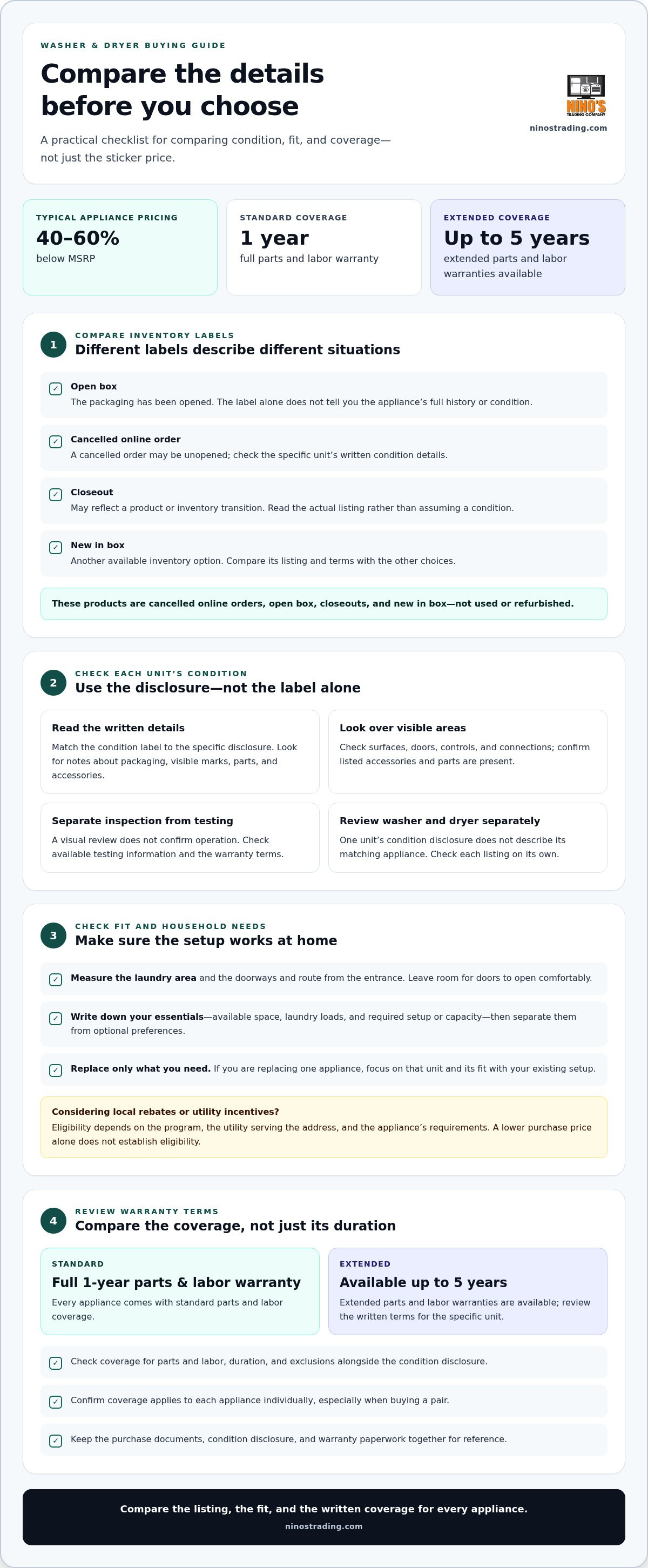
A lower price doesn’t have to mean buying used. Shoppers looking for cheap washers and dryers in Fayetteville, AR can compare open-box, closeout, cancelled online order, and new-in-box appliances; these are not used or refurbished. Appliance prices typically run 40 to 60% below MSRP, and every appliance comes with a full 1-year parts and labor warranty, with extended parts and labor coverage available up to 5 years.
A low sticker price is only part of the decision. An appliance’s condition and warranty terms matter, too. Open-box washers and dryers can offer value, but it’s important to understand what the condition label means and what coverage comes with the purchase.
This guide explains how to compare washer and dryer prices without relying on a one-size-fits-all dollar figure, and what to check in condition disclosures and warranty terms. You’ll also learn how to weigh open-box options against closeout and new-in-box appliances, so you can find a setup that fits your needs and budget.
Key Takeaways
- Compare open-box, closeout, cancelled-order, and new-in-box options to find the condition and value that suit your household.
- Use the appliance’s condition disclosure to understand what you’re buying before making a decision.
- Review what parts and labor coverage includes, and consider whether extended protection fits your needs.
- Compare washer and dryer options based on your laundry needs, available space, and preferred setup.
- Learn which details can shape a smooth buying experience, from choosing an appliance to understanding its terms.
Laundry appliances
Washer and dryer inventory may include new-in-box, open-box, cancelled-order, and closeout appliances. These labels describe different inventory situations, not one shared condition. A cancelled online order, for example, may be unopened, while an open-box unit has had its packaging opened. A closeout may reflect a product or inventory transition. Read the specific condition description rather than assuming every discounted appliance has the same history.
Returned and display appliances can enter resale inventory in different ways. A customer may return an order, or a retailer may move a display unit out of a showroom. That general context doesn’t establish the history of a particular washer or dryer. Check the listing for its actual condition label and any details about packaging, visible marks, included parts, or accessories. “Open box” alone doesn’t tell you whether the appliance was displayed or simply unboxed.
Inspection and refurbishment are different. An inspection assesses an appliance’s condition; refurbishment involves restoring or repairing it. Use a simple review process when comparing a unit:
- Match the condition label to the written disclosure.
- Look over visible surfaces, doors, controls, and connections.
- Check that listed accessories and parts are present.
- Read the warranty terms alongside the condition information.
These steps can help you identify questions about a specific unit without assuming that every open-box appliance has the same marks or history. A display model, for instance, may show signs of handling, while an unopened cancelled order may not.
Testing is a separate step. A visual inspection can reveal surface damage, but it doesn’t show whether a washer completes a cycle or a dryer heats and runs. Don’t treat a cosmetic review as proof that an appliance operates properly. Check the available testing information and warranty terms to understand what has been assessed and what coverage applies. For laundry pairs, review each unit separately: a washer’s disclosure doesn’t describe its matching dryer.
Protection plans are another part of the buying decision. Start with the standard warranty, then compare any extended plan’s coverage for parts and labor, duration, and exclusions. An extended plan is most useful when its written terms address concerns that matter to your household. Keep the purchase documents and condition disclosure together so you can easily refer to the appliance’s stated condition and coverage.
Before choosing an extension, read its written terms beside the standard warranty and the appliance’s condition disclosure. Confirm what coverage applies to the washer and dryer individually, and note any exclusions, duration, and parts or labor provisions. The store offers appliance warranty extensions of up to 4 years. Treat that length as one comparison point, not as a substitute for checking what the plan actually covers.
Keep the terms with your purchase documents and listing details, and make sure the plan applies to the unit you’re buying. If a disclosure is unclear, get clarification before completing the purchase. A clear record of the condition and coverage helps you refer back to what was represented if questions arise. Compare the added cost with the plan’s stated coverage and your priorities, rather than choosing an extension based on duration alone.
Customer experiences buying washers and dryers
A smooth purchase starts with your laundry area, not the appliance display. Measure the available space, doorways, and route from the entrance before comparing models. A washer may fit beside the dryer but leave too little room to open the doors comfortably. These measurements give shoppers looking for cheap washers and dryers in Fayetteville, AR a practical way to narrow their options.
Local rebates and utility incentives in Fayetteville depend on the program, the utility serving the address, and the appliance’s eligibility. Requirements may specify qualifying models or energy-efficiency criteria, so a lower purchase price alone doesn’t establish eligibility.
Separate requirements from preferences to make your selection easier. Write down the available space and the laundry loads your household handles. Then list features you need, such as a particular setup or capacity, and distinguish them from features you simply prefer. If you’re replacing only a dryer, for instance, focus on that appliance rather than assuming you need a matching pair.
- Measure the laundry space and delivery path.
- List essential features separately from optional preferences.
- Compare model details and the appliance’s disclosed condition.
- Keep purchase documents and warranty paperwork together.
Condition details matter, especially for open-box or cancelled-order appliances. Read the disclosure for the specific unit and note details about packaging, visible marks, or included accessories. “Open box” is a broad label, not a full account of an appliance’s history. Compare the written details to evaluate options without assuming two units are in identical condition.
Before deciding, match the model information in the listing to the washer or dryer you’re considering. Review the purchase terms for each appliance individually, particularly when buying a pair. One unit’s disclosure doesn’t automatically describe the other. This careful comparison helps anyone weighing cheap washers and dryers in Fayetteville, AR against options with different condition labels or included items.
Keep your priorities in view as you compare. A renter with limited laundry space may care more about dimensions and access than appearance, while someone replacing a single appliance may focus on compatibility with the existing setup. Write down your deciding factors before browsing and use them consistently. This keeps the purchase centered on what will work at home.
Warranty coverage
Warranty terms explain what support applies if a washer or dryer develops a covered problem. Start with the written warranty for the specific appliance, not a general description in an advertisement. Confirm the coverage period, covered parts, labor terms, exclusions, and steps for requesting service. Keep these details with your purchase record so you can refer to the exact terms later.
Parts and labor are separate elements of coverage. Parts coverage concerns eligible components, while labor coverage concerns work performed on a covered repair. Read both descriptions together. A document may describe parts coverage clearly but explain labor in a separate section. The warranty’s wording determines how those terms apply, so don’t infer coverage from the appliance’s condition label.
Before buying, match the warranty paperwork to the washer or dryer you’re considering. Compare the model information on the document with the appliance listing, then note when coverage begins and any stated exclusions. If you’re looking at a pair, review each unit’s terms independently. A washer and dryer can have different model details, disclosures, or documents, even when sold together.
- Identify the appliance and model covered by the document.
- Read the coverage period and parts and labor language.
- Review exclusions and the stated claim process.
- Save the warranty and purchase records together.
Extended protection is a separate decision from understanding standard coverage. Compare the extended plan’s duration, covered parts, labor terms, and exclusions with the standard warranty. Check for overlap with existing coverage and note when the plan’s terms begin. This will help you judge whether added protection addresses a concern that matters to your household.
An open-box unit or showroom display may have a different condition disclosure from a new-in-box appliance. That difference doesn’t establish the warranty terms. Read the appliance’s written coverage alongside its condition details. Visible marks describe appearance; warranty terms describe covered repairs. Keep those details distinct when comparing options.
Clear records make later questions easier to handle. Save the listing or condition disclosure, purchase receipt, warranty document, and any extended-plan paperwork. If a problem arises, describe it plainly and follow the claim instructions in the applicable document. For example, if a washer stops mid-cycle, its model information and purchase details will help identify the appliance. Organized paperwork connects the unit, the reported issue, and the coverage terms without relying on memory.
Condition disclosure and pricing
Condition labels help explain why similar washers can have different prices. New-in-box, open-box, cancelled online order, and closeout describe different inventory situations. A label alone doesn’t describe every appliance’s appearance or packaging. Read the specific disclosure for the unit you’re comparing, including details about marks, missing accessories, or packaging.
For a useful comparison, start with the appliance type and model information. Then compare condition, included items, and warranty terms. A washer with opened packaging isn’t automatically the same as a display appliance. Likewise, a closeout label doesn’t tell you whether the unit has visible cosmetic marks. The disclosure provides context that a price tag cannot.
Washer and dryer delivery and installation costs in Fayetteville depend on the services included and your home’s setup. Delivery and installation may be separate charges, while access, existing hookups, and removal needs can affect the total. Compare the written service details before budgeting.
Consider the appliance price separately from other purchase costs. If you’re replacing a washer, for example, you may also need to budget for delivery, installation, or changes to your laundry setup. These are separate from the appliance’s listed price. Keeping them distinct helps you compare options without mistaking an appliance discount for the full project cost.
Use this practical review before choosing:
- Identify the exact washer or dryer and its condition label.
- Read the disclosure for visible marks and included accessories.
- Compare warranty terms for the specific appliance.
- Separate the appliance price from delivery and installation details.
The same comparison method applies to refrigerators, where packaging and cosmetic condition can differ between units. Compare like with like: appliance type, model information, disclosed condition, and stated coverage. For a washer comparison, focus on washers instead of mixing different appliances or condition categories.
Consider a pair with one open-box dryer and one new-in-box washer. Review each disclosure separately, then compare the written terms for both. Don’t assume the pair shares one condition description or identical documentation. If a disclosure mentions a mark, note its location and appearance, then weigh that information alongside the appliance’s fit and coverage.
A clear comparison doesn’t require guessing what a label means. Use the written disclosure to understand the unit, and keep delivery or installation costs separate from appliance pricing. With those details organized, you can decide whether the overall purchase suits your household and compare options on more than the displayed price alone.
Open-box washers and dryers
“Open box” describes packaging status, not a washer or dryer’s complete history. The carton may have been opened, but the label alone doesn’t explain why or what happened afterward. One appliance may have opened packaging with no visible marks; another may show a scratch. Read the unit’s own condition disclosure before comparing options.
That distinction makes open-box shopping about more than price alone. A lower price can be appealing, but value depends on the stated condition, included items, and terms. For example, a washer with a disclosed cosmetic mark may suit someone who prioritizes function over appearance. A shopper who wants an untouched exterior may prefer a different condition category.
Review an open-box washer and dryer as separate appliances, even when they’re presented as a pair. The washer’s disclosure describes that unit, not necessarily the dryer beside it. Compare model details, packaging notes, visible-condition information, and listed accessories for each. If the dryer’s paperwork mentions a mark and the washer’s does not, keep those details separate.
Use a simple review process before deciding:
- Read the condition label and the full unit-specific disclosure.
- Look for details about packaging, cosmetic marks, and included items.
- Compare each appliance’s model information and purchase terms.
- Keep records for the washer and dryer separately.
Read inspection language carefully, too. “Inspected” and “refurbished” don’t mean the same thing: one describes an assessment, while the other suggests restoration or repair. A condition label alone doesn’t establish that an appliance was tested or repaired. Use the written description to understand what it says instead of assuming what happened based on the open-box category.
Imagine choosing between an open-box washer and a new-in-box model. Compare their condition disclosures first, then consider whether packaging or a visible mark matters to your household. Next, review the warranty documents and included accessories. This makes the trade-off clearer without treating every open-box unit as identical.
Open-box can be a sensible option when the disclosed condition and terms fit your priorities. If you’re ready to compare open-box washer and dryer options, use the unit-specific details to guide your choice.
Nino's Trading Company: Refrigerators
Nino's Trading Company offers washers and dryers for shoppers comparing laundry appliances with other household needs. Use your measurements and priorities to focus on options that suit your home.
As you compare, keep each appliance’s condition details and purchase terms in view. This helps you make a considered choice instead of focusing on one feature alone.
Explore your options at Nino's Trading Company online.
Make the Next Appliance Choice Work for Your Home
Before buying, consider how the appliance will fit your household in the coming years, not just today’s laundry routine. A growing family, changing schedule, or planned move can affect which washer or dryer feels practical. Decide what needs replacing now and what can wait, then compare options against that priority.
For shoppers weighing cheap washers and dryers in Fayetteville, AR, bring your measurements and preferred condition category into the decision. That keeps the focus on appliances that suit your space and needs. Nino's Trading Company offers washers and dryers, refrigerators, and TVs, so you can consider more than one household purchase in the same shopping process.
If you’re ready to explore your options, contact Nino's Trading Company today. Take the next step at your own pace and choose what makes sense for your home.
Frequently Asked Questions
Where can I buy affordable washers and dryers in Fayetteville, AR?
Nino's Trading Company serves Fayetteville shoppers comparing affordable laundry appliances. Before choosing, consider how the appliance will fit your routine, laundry space, and household priorities. If you’re replacing only one unit, focus on the features and setup that work with the appliance you plan to keep. A clear list of needs helps you compare options without getting distracted by extras.
What should I check when buying a used washer and dryer in Fayetteville, AR?
Before buying a used appliance, ask to see the washer and dryer run through their functions. Watch for leaks, unusual sounds, lingering odors, and unresponsive controls. Inspect hoses and cords for visible damage, and confirm the units can be moved into your laundry space. If you’re buying a pair, test each appliance separately; one unit’s performance doesn’t establish the other’s condition.
What are the cheapest new washer and dryer sets available in Fayetteville, AR?
New-in-box washers and dryers are available, and appliance prices typically run 40 to 60% below MSRP. Compare specific models and prices to find the lowest-priced set.
Which affordable washer and dryer models have the best reliability and warranty?
No model-specific reliability ranking is available. Compare each appliance’s condition disclosure and model details; every purchase includes a 1-year parts-and-labor warranty, with extended coverage potentially available.


