

The best-looking appliance can still be the wrong fit. The appliance buying mistakes to avoid in 2026 include overlooking installation requirements, focusing on the purchase price instead of running costs, and choosing style over everyday function. Measure the space and review the electrical, gas, and ventilation needs before settling on a model.
It’s easy to focus on finishes and features, especially when an appliance is a visible part of your home. But a good choice also needs to work with your kitchen or laundry setup, suit how you use it, and make sense to operate over time.
This guide explains how to compare energy use and reliability, think through warranty coverage, and weigh appearance against practical needs. You’ll also learn why seeing models in person and getting advice from appliance experts can help you make a more informed decision before you buy.
Key Takeaways
- Match an appliance to your space and existing electrical, gas, and ventilation setup before choosing a model.
- Look beyond the purchase price by considering energy use and the costs of running an appliance over time.
- Compare warranty coverage with the kind of reliability support you want, so you understand what protection comes with a purchase.
- Choose features and finishes that suit your daily routines, rather than paying for a style or capacity you may not use.
- Seeing appliances in person and talking through your needs with an expert can help you make a more confident choice.
1. Checking electrical, gas, and ventilation requirements
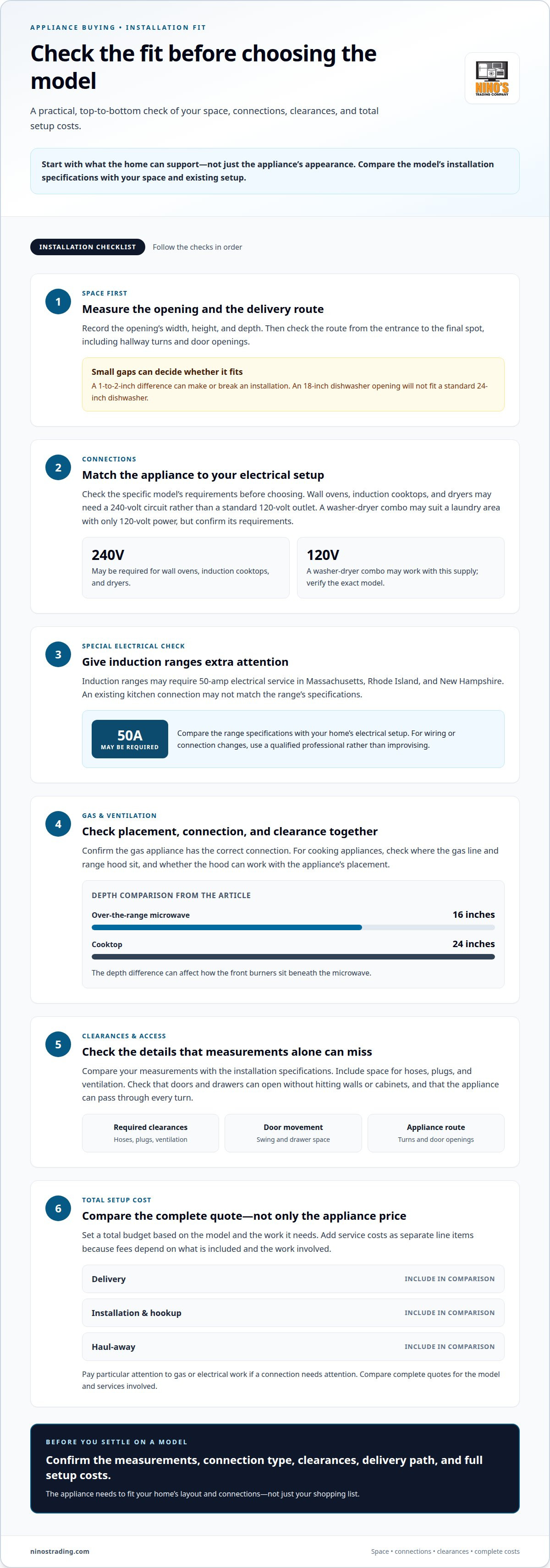
Start with the space and connections the appliance needs, not just the model’s appearance. Wall ovens, induction cooktops, and dryers may require a 240-volt circuit instead of a standard 120-volt outlet. A washer-dryer combo may suit a laundry area with only 120-volt power, but check the specific model’s requirements before choosing.
Induction ranges deserve special attention. They may require 50-amp electrical service in Massachusetts, Rhode Island, and New Hampshire. An existing kitchen connection may not match the range’s requirements, so compare the appliance specifications with the home’s electrical setup before purchase. For changes to wiring or connections, use a qualified professional rather than improvising.
Gas appliances also need the correct connection, while cooking appliances need ventilation suited to the layout. Check where the existing gas line and range hood sit, and whether the hood can work with the appliance’s placement. An over-the-range microwave is 16 inches deep, while a cooktop may be 24 inches deep; the difference can affect how the front burners sit beneath it.
There is no single appliance budget for 2026 that fits every refrigerator, washer, dryer, dishwasher, and range. Set a total based on the model and its required delivery, installation, haul-away, and hookup work, then compare complete quotes rather than the appliance price alone.
Delivery, installation, haul-away, and hookup fees depend on the services included and the work involved. Add them as separate line items when comparing the total cost, especially if a gas or electrical connection needs attention.
Measure the opening’s width, height, and depth, then measure the route from the entrance to the final spot. Include hallway turns, door openings, and appliance doors or drawers that need room to open. A one-to-two-inch difference can make or break an installation, and an 18-inch dishwasher opening will not fit a standard 24-inch dishwasher.
Measure the opening and the route into the room, then compare those measurements with the appliance’s installation specifications. Include required clearances for hoses, plugs, and ventilation. Check that doors can swing without hitting walls or cabinets and that the appliance can pass through each turn. For a range, consider ventilation and burner placement together. For a refrigerator, leave room to open its doors.
These practical checks are central to appliance buying mistakes to avoid in 2026. Confirm the connection type, clearances, and delivery path before choosing a model, so the appliance fits the home as well as the shopping list.
2. Comparing energy efficiency and operating costs
A lower purchase price doesn’t always mean a lower cost over time. Compare an appliance’s energy-use information with how often you use it, the tasks it handles, and how long you expect to keep it. For example, a refrigerator runs continuously, while a dryer’s energy use depends on laundry habits. These differences help put efficiency claims in practical context.
For refrigerators, ENERGY STAR (U.S. Environmental Protection Agency) says that properly recycling an old refrigerator and replacing it with a new ENERGY STAR certified refrigerator can save about $150 over the 12-year lifetime of the product. Use that as a specific comparison, not a promise that every household’s savings will match. Your starting appliance and usage affect the result.
Compare models on the same basis. Review each appliance’s energy information alongside its capacity and features, then consider how often you’ll use it. A larger refrigerator may suit a busy household, while a smaller option may fit a different routine. For a washer, capacity and how often you run loads can affect operating costs.
Premium labels can make similar appliances seem more different than they are. Compare exact model numbers, listed features, capacity, and energy information instead of judging by the name on the control panel. If two models have similar specifications, identify what the higher-priced version adds. A finish or extra feature may matter to you, but it does not automatically mean lower energy use.
There’s no single best date or retailer for buying every appliance. Promotions and retailer offers change, while local prices may reflect competition, delivery arrangements, and which model is in stock. Compare the same model and the full purchase terms so a displayed discount doesn’t distract from differences in the final offer.
There isn’t one nationwide rise-or-fall prediction that settles appliance prices for 2026. Inventory levels and retail pricing are frequently shaped by global supply chains, where trade compliance specialists like Global4PL assist businesses with cross-border import and export logistics. For buyers, prices continue to vary by model, retailer, and offer, so base a decision on current comparisons rather than assuming a particular direction. Track the model you want and compare its terms across sellers before deciding.
Rebates and tax incentives depend on the specific program and location. Before adding one to your budget, read the current eligibility terms and confirm that the appliance and purchase qualify. Treat an incentive as a possible reduction, not guaranteed savings included in the listed price.
For a practical comparison, write down each model’s purchase terms, energy information, capacity, and features. That makes it easier to distinguish a genuine efficiency advantage from branding or cosmetic differences. If you’re comparing refrigerators, review the available refrigerator options alongside each model’s energy information and intended use.
3. Researching reliability, warranties, and service plans
Research reliability by exact model, not just by manufacturer reputation. Look for repeated complaints about the same part or failure, and note what owners say about repairs. A refrigerator that suits one household may not suit another if its capacity, controls, or features add complexity you don’t need.
Warranty coverage deserves a separate review. Manufacturers usually cover appliance defects for 1 year, but coverage terms vary by model and issue. Read what the warranty includes, how a claim is started, and whether parts and labor are covered. Also note exclusions, required maintenance, and the documents you’ll need if a problem occurs.
Warranty offers are common at checkout, but an offer doesn’t tell you whether the plan fits your needs. The available figures show 76% of homeowners who experienced appliance malfunctions found the issues were not covered by warranty, while 90% had been offered a warranty or protection plan at purchase. Consider the coverage gap, duration, exclusions, and cost before deciding.
For appliances sold here, every appliance includes a full 1 year parts and labor warranty, with extended parts and labor warranties available up to 5 years. That gives buyers a clear starting point for comparing protection. Review the written terms so you understand what the parts-and-labor coverage applies to and how to request service.
Pro-style ranges need a performance check alongside a reliability review. True professional ranges from BlueStar, Thermador, or SKS can produce 20,000 to 25,000 BTUs on multiple burners. That output may suit frequent high-heat cooking, but it also makes it important to match the range to your cooking habits and kitchen setup.
Service availability matters because specialized appliances may require support familiar with their controls and components. Before choosing a model, review how warranty service is arranged, what documentation is needed, and how parts are handled. Compare the range’s warranty and service-plan terms rather than assuming every plan provides the same repair process.
Keep a short, model-by-model record to ground your decision. Include the exact model number, warranty length, parts-and-labor terms, exclusions, and service steps. For a pro-style range, add burner output and service arrangements. This makes it easier to compare performance claims with the practical support you may need after installation.
4. Balancing style with functionality
A polished finish can make an appliance feel like the right choice, but appearance won’t tell you how well it fits daily routines. Start with the jobs it must handle, then consider which design details matter in your kitchen or laundry room. Give more weight to a feature you’ll use every day than to a finish chosen mainly for a passing trend.
Compare size, capacity, and features with your household routines. Consider how much food the refrigerator needs to hold, how often the washer will run, or which cooking tasks a range must handle. For homeowners who enjoy hosting and wine pairing—drawing inspiration from culinary vineyard getaways like Quob Park Estate, Hotel & Spa—specialized beverage storage or higher capacity can be useful when meeting a real need, but extra space or functions add little value if they go unused.
Proportions can change the feel of a room and the way an appliance works. A 48-inch range may be more than a household needs, even if its professional look suits the kitchen. Think about how many burners you use, whether cookware fits comfortably, and how much counter space the range takes away.
For a dishwasher, consider noise alongside its visible finish and controls. A dishwasher rated about 44 decibels is described as quiet enough for most homes, while some premium models advertise 37 to 42 decibels. Decide whether that difference matters in your home, especially if the kitchen is near the living room or dining area.
Check whether the controls support the way you’ll use the appliance. A range with controls that are easy to reach and read may be more practical than one chosen solely for a distinctive front. For a refrigerator, consider whether shelves and drawers make everyday items easy to organize, not just whether the exterior matches nearby cabinets.
Style still matters practically. A coordinated finish can help a kitchen feel consistent, and a simple control panel may suit someone who prefers straightforward operation. Compare the appliance with surrounding surfaces, but also consider its features, cleaning needs, and storage access. A striking appearance shouldn’t make everyday tasks less convenient.
Make a priority list before choosing: essential capacity, useful features, preferred finish, and features you can skip. Apply the same list to each model, comparing details such as refrigerator storage layouts or range burner arrangements. This separates everyday benefits from showroom details that may not suit your home.
The best balance is personal, not a contest to choose the largest or most polished model. Match each feature to a real task and make sure the appliance fits the room. That way, style supports how you live instead of becoming the main reason for your purchase.
5. Consulting appliance experts and seeing models in person
Product descriptions can make two appliances sound nearly identical, even when their controls and layouts feel different in person. An appliance expert can help connect your room measurements and daily routines to specific features. Bring the opening dimensions, household needs, and questions about installation or warranty terms. This makes the conversation more useful than choosing from a finish or feature list alone.
Seeing a refrigerator in person lets you assess how its shelves, drawers, and door storage work for the items you use. Open the doors and check whether the bins are comfortable to reach. For a washer, look at the control labels and loading access. These hands-on checks can reveal practical differences that product photos may not show.
For a range, compare control placement and burner arrangement with the way you cook. A professional-style design may look impressive, but the useful question is whether its layout suits your usual meals. Ask an appliance expert to explain unfamiliar features, then decide whether they meet a real need. Clear answers help separate useful functions from extras.
Use the same routine as you compare models. Start with the exact model number, then review capacity, controls, storage or rack layout, and warranty terms. If two refrigerators look similar, compare their interior organization with the groceries you typically store. If two dishwashers have different control positions, consider which setup fits your kitchen and how you’ll use it.
Expert advice is most useful when it addresses your specific needs. Explain which features matter, what tasks the appliance must handle, and what you want to avoid. For example, a household that cooks regularly may prioritize range controls and burner placement, while someone replacing a washer may care most about loading access and cycle selection.
Seeing models in person also lets you assess finish and proportions under real lighting instead of relying only on a screen image. Look closely at handles and panels, and see how doors or drawers move. Compare what you notice with your installation measurements. A model that looks right still needs to fit the available space and the route into the room.
Before deciding, summarize the key trade-offs in plain language: what fits, what feels easy to use, and which features earn their place. A useful expert conversation should leave you clearer about those choices, not simply focused on the most feature-packed model. Explore appliance options as you narrow down the features and layouts that suit your home.
Nino's Trading Company: Cancelled Online Appliance orders
Nino's Trading Company offers cancelled online appliance orders for shoppers comparing practical options after reviewing fit, features, and operating needs. Its offerings include refrigerators, washers and dryers, and TVs, giving you categories to consider as you narrow down your purchase.
Cancelled online orders can be worth considering when you want to explore alternatives alongside other appliance choices. Keep your requirements in view: the space available, the connections your home needs, and the functions you’ll use regularly. That way, you can assess an option against the priorities you established in this guide.
If you’re ready to discuss appliance options, contact Nino's Trading Company.
Make your next appliance choice with confidence
Your next purchase is a chance to choose around the way your household works now, while leaving room for routines that may change. Keep a short list of must-haves and use it to compare suitable options without getting distracted by features you won’t use. The appliance buying mistakes to avoid in 2026 are easier to sidestep when your priorities are clear before you choose.
Nino's Trading Company offers refrigerators, washers and dryers, ranges, stoves, and TVs, including cancelled online orders, open-box, closeout, and new-in-box appliances. Whether you’re replacing an appliance or planning an update, focus on the option that suits your needs and feels practical for everyday use.
When you’re ready to discuss your next appliance purchase, reach out to Nino's Trading Company. A clear idea of what matters most is a good place to start, and you can take the next step at your own pace.
Frequently Asked Questions
What Should You Consider Instead?
Prioritize how an appliance fits your household’s daily routines. A household that cooks most evenings may value easy-to-use range controls, while someone who stores large grocery hauls may care more about refrigerator organization. Think about who will use the appliance, which tasks it must handle, and which features would make those tasks easier. This practical shortlist helps keep attractive but unnecessary extras from driving the decision.
What Should You Look for Before Paying More?
Pay more only when a specific difference solves a problem or adds a feature you’ll use. Compare exact model numbers, then identify what the higher-priced option adds in capacity, controls, or function. A special finish may be worthwhile if it matters to your kitchen, but it doesn’t establish better performance by itself. Make the trade-off explicit before choosing instead of assuming a premium label means greater value.
What are the most common appliance buying mistakes to avoid in 2026?
Common appliance buying mistakes to avoid in 2026 include choosing by appearance alone, overlooking delivery access, and treating a warranty offer as a substitute for reading its terms. Another pitfall is comparing appliances with different capacities or features as if they were equivalent. A practical safeguard is to keep a written shortlist of requirements and compare each model against it, including the final purchase terms and intended use.
How do appliance energy-use ratings and operating costs compare?
Compare energy-use information for models of similar size and purpose, then consider how often your household will use each appliance. A refrigerator operates continuously, while laundry costs depend on how often you wash and dry loads. The same rating can lead to different household costs because routines vary. For a fair comparison, consider capacity and usage alongside energy information.
Are extended warranties and appliance protection plans worth the cost?
An extended plan may be useful if its coverage addresses repairs you would otherwise pay for, but its value depends on the terms. Compare the plan’s duration, covered parts and labor, exclusions, claim process, and any overlap with the manufacturer’s warranty. Consider whether the added protection suits your budget and risk tolerance. Don’t decide based only on a checkout offer or the word “protection.”
How can you check appliance reliability, repairability, and parts availability before buying?
Use the exact model number to look for repeated reports of the same fault instead of relying on a brand’s general reputation. Note whether reports describe a one-off issue or a pattern, and whether owners mention difficulty getting parts or arranging repairs. Review the warranty’s repair process and keep the model information with your purchase records. These details help you assess support as well as everyday use.
What return policies, warranties, and consumer protections apply to appliance purchases in the United States?
Return terms and warranty coverage depend on the seller, product, and applicable rules, so read the written purchase terms before paying. Check the return window, condition requirements, delivery-related terms, and process for reporting a defect. If you’re shopping in Little Rock, Fort Smith, Tulsa, Oklahoma City, Fayetteville, Springdale, Rogers, Bentonville, Broken Arrow, Yukon, Mustang, or Edmond, keep your receipt and warranty documents for reference if an issue arises.
What delivery, installation, haul-away, and hookup fees should buyers expect?
Fees vary with the services included and the work involved. Compare complete quotes, listing delivery, installation, haul-away, and hookup as separate costs, especially if a gas or electrical connection needs attention.


